Search This Blog

Saturday, July 31, 2010

Succession of bloom: Columbines in the Hobbit Garden

I'm late with this post since it's no longer spring and the Columbines have ceased to bloom.  June turned out to be a series of trips resulting in weeds going to seed in epic proportions.  So I've been trying to remove seedheads and get them out of the yard before I have 7 years of bad weed luck. 

Anyway, I like to have a succession of bloom in spring, starting with Hellebores, Pulmonaria, early Narcissus, Muscari, and species tulips, like the very dependable red Tulipa praestans unicum.


Muscari neglectum is a good naturalizer that makes a clump-


Another early bloomer that makes quite a show is Vinca minor, here the variegated form adds a little sparkle to a shady place.


A few weeks later, the Anemone nemerosas make charming clumps.


But as charming as all these are in the spring, when the Columbines start to bloom in a area that was supposed to be a rose garden, they achieve an atmosphere of aerie faerie abandon that is worthy of a hobbit garden.


These are all grown from seed.  The double form is delightfully fluted and ruffled, like little pinafores. 


This is the single dwarf form, which comes also in several colors.  This is as close to red as they get.  The columbine foliage is also delightful, and persists all year.  The chartreuse mound behind it is a nice Oregano grown from seed.


Some of the single blooms are bicolored, as well.  The one drawback is that the tall seed heads must be cut off later.  I save up the seed to sprinkle on unruly areas of the yard to get more Columbines started.

An update on some of my earlier photos- the Lychnis coronaria is now tall and blooming.

The driveway bed which has a lot of Rubus calycinoides ground cover and was cleared last winter from a large Mugho Pine shrub, is doing well with a mixed group of Rudbeckia from Thompson and Morgan.


The Coreopsis tinctoria started blooming early and looks nice in a basket but is rather small to have much impact in the bed above.   These seeds came from J.L. Hudson, Seedsman, which has a large variety of seeds but not many that are natives.


Some Achillea millefolium Colorado, and Anchusa Azurea may eventually bloom.


Fireweed, Chamerion (formerly Epilobium) angustfolium, is one of those native wildflowers that can take care of itself.  I was surprised to see a hummingbird sipping from its blossoms as well.  I usually remove the seed heads to restrict reseeding.  Another reliable bloomer that takes care of itself but has not reseeded for me is Stachys betonica, unfortunately not a native.


Well, back to weeding.  Here is a bed that was partly planted in June and more plants added this week; it will take a while for them to fill in.  Happy growing!

Saturday, May 15, 2010

Bodacious, boisterous but incorrigible Borages

I've been slowly realizing how many members of the Borage family, now called the Hydrophyllaceae, have come to grow in my yard, and to succeed, many fantastically.  My favorite ground cover, Symphytum grandiflorum, pictured in my introductory post, is one such.  A similar plant is regular Comfrey, which is tall with purple flowers in spring.  The fuzzy leaves are supposed to make good animal feed and good green stuff to hasten decomposition and boost mineral content of compost piles.  The Comfreys fall into the incorrigible category, don't even think about trying to get rid of them.

The annual herb Borage self-sows very easily, and is coming up now.  It can be chopped finely and eaten in salads, with a cooling cucumber-like taste, and also has an edible blue flower that is a colorful addition to a salad.   The young leaves can also be cooked like spinach, or used to flavor other dishes.  The stems can be peeled and eaten like celery.  In ancient times, the herb was thought to increase courage and was used before battle to flavor wine by the Celts.  Borage is also an excellent plant for attracting bees to the garden.  I like to let it volunteer in my squash and cucumber beds to draw the bees.  It can become an imposing 3-5 foot plant studded with blue star flowers. 

Then there are the wonderful Pulmonarias, Lungworts.  These plants have a wonderful variety of leaf shapes and colors, most variations on a theme of dark fuzzy green swirled or spotted with varying amounts of silver. 

Roy Davidson
They do best in shade or part shade, where they don't need much water in summer, but in the hot summer sun they can wilt dramatically.  They make an early spring show of various colors, from a deep cobalt blue,

Excalibur
fading pink (deep colors not photographing true to nature), to various shades of purple, light blue, pink,

David Ward
peach, and white.  So a few different plants can add quite a variety of attractive spring blooms, and the plants also self-sow sparingly, so the plants slowly increase in beds and can hybridize delightfully to create your own special blends of flower and leaf colors.

Mrs. Moon
Another fantastic plant is Brunnera macrophylla, Bigleaf Brunnera or Siberian Bugloss.  It has lovely heart-shaped leaves, and tiny forget-me-not type blue flowers in spring, in abundant sprays.
Brunnera
There is also a silvery form, 'Jack Frost', that I don't have, and a variegated form with added allure-
Brunnera  'Variegata'
These plants do best in shade or part shade, and will gently self-sow.

Then we get to the biennnial forget-me-nots, which will self-sow with a vengeance, Myosotis, I was given them so best guess is arvensis.  They will come up with reckless abandon, blanketing large areas.  This looks really beautiful for a while, though it seems mildew inevitably appears on the scene as the flowers start going to seed, when they become a pain to rip out.  But for a while they are a blue cloud of loveliness.
 
Myosotis
Various nurseries have developed pink, white, or varied blooms, and there are also annual forms.   There is also the perennial forget-me-not Omphalodes, with larger flowers and entrancing variations like 'Starry Eyes', blue petals lined with white edges.  These are lovely but so delicate they have not persisted in my garden.  There is even a native tiny forget-me-not, Myosotis laxa, only 4-16" tall and with tiny blue flowers fading yellow, in the famed spiral Borage scorpiod inflorescence toward the left corner, and fuzzy leaves.  Blogspot keeps turning this photo on its ear, arghh.  The tiny flowers are a deeper blue/yellow than pictured.  Cute.
Myosotis laxa
Another tiny native Borage that makes a vine with tiny oakleaf-like incised leaves, is Nemophila parviflora, with tiny white cup-shaped blossoms
Nemophila parviflora
But a woodland ground  cover of a larger size can also be found, capable of carpeting expanses of cool woodland floors, Hydrophyllum tenuipes, the Pacific waterleaf, here show with flower buds in a fuzzy ball.

Hydrophyllum tenuipes
Finally, there is the largest of the native Borages in my yard, which can attain 3-5' in height, crowned with one-sided coiled inflorescences that are intensely fuzzy with inconspicuous greenish flowers with protruding stamens.  They won't be in bloom for a while, this is the plant at this date, if you saw the bloom you would understand the common name, the Shade Scorpionweed.

Phacelia nemoralis
  I have a couple more Borage family members that I'm growing from seed but haven't seen blooming yet, Anchusa azurea, and Alkanet officinale which get 3-4' tall and 2' tall, with more blue flowers.  I'm also growing the house plant Heliotrope from seed, they are doing well so far but far from blooming.

So, a successful group of plants, very useful in the War on Weeds.  And a source of a rare garden color, true blue.  One of my pet peeves, have you noticed how often plant breeders try to breed the color blue into plants that just don't have the genetic potential for the color, like daylilies, and call various shades of magenta "blue" as though all of us are colorblind.  LOL

Hannah

© Weeding on the Wild Side, all rights reserved. Any material copied must link back to this website, http://weedingonthewildside.blogspot.com

Thursday, May 6, 2010

Serendipity Happens: a Weeding Discovery

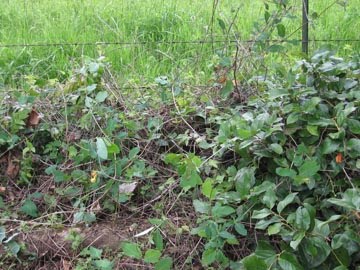
I couldn't believe my eyes!  Life is full of surprises, and in addition to enjoying working out in all that fresh air, doing 2 hours of weeding on the bed pictured in my Paradise lost post, I made a fun discovery.  In removing several years of spent Himalayan blackberry vines and a tangle of the native Trailing blackberry, Rubus ursinus, and some hanging branches of the Western Red Cedar, I found some of the expected dwarf Cascade Oregon Grapes, and a nice clump of Salal, which had winding through it a number of vines (!) of the native Orange Honeysuckle, Lonicera ciliosa, aka the Western Trumpet Honeysuckle.  I had been wanting this choice native honeysuckle for several years, because hummingbirds would love it, and here it was in my backyard all the time!   And in addition I generated another pile of branches and vines to run through the chipper (free mulch!), including the Cedar branches, which always release a heady cloud of heavenly perfume as the leaves are chipped.  And here is the finished bed after weeding-
Here is the nice Honeysuckle, a cluster of blooms in a leafy bowl created by the last 2 leaves joined
in a disk.   Even this plant is supposed to have edible berries, though I haven't tried them..... yet.

Here's the nice clump of Salal, Gaultheria shallon.  It's native, and has a berry that is edible even raw-
it helps to be hungry- created to be healthy eating, with a nice complement of anti-oxidants from the dark purple pigments- anthocyanins, like Oregon Grape, though not tasty like a blueberry, and can make a dense 3' growth that can overrun the more delicate Cascade Oregon Grape and Trilliums.

The trick is keeping the Trailing Blackberry, aka Vegetable Barbed Wire, from just growing back over all the plants, not to mention the Himalayan blackberry.  At least it is nice to have weeds that make a tasty berry too.  The Western Trumpet Honeysuckle has been rated 2 out of 5 for food uses and medicinal uses by the database, Plants for a Future .   The Pacific Northwest proves once again to be a great place to garden!

Hannah

© Weeding on the Wild Side, all rights reserved. Any material copied must link back to this website, http://weedingonthewildside.blogspot.com

Saturday, May 1, 2010

Progress in No-weed Beds

Here is a sample bed I'm working on, one of my worst weed-infested beds since it is next to the lawn full of unscrupulous grasses knowing no boundaries and giving no quarter.  I initially killed the grasses and weeds in this bed with newspaper and black plastic, and this lasted for a while but the main plants in the bed were too vertical, like irises and daylilies, and some fig trees, and there was not enough ground coverage so the grasses invaded again.  This first bed had a second newspaper treatment over winter and is partially bare enough to allow planting some new plants that should give better leaf coverage, some hollyhocks.

The next photo is of an area where some Columbines and Figwort are already growing and competing with the grasses for coverage.


This bed, solidly planted for several years, has attained nearly no-weed status, with early spring bloom from Hellebores and species Tulip batalinii Bright Gem, and tree Peonies, and summer bloom from hardy Geraniums-

And along the driveway under some Red Cedars, I planted sword ferns, and variegated Vinca minor 'illumination', but the grey-green clumps of Rose Campion, Lychnis coronaria, sowed themselves in a row that will burst into deep hot pink blooms later in summer.


A sloped bed that is a work in progress, also winter-killed with newspapers, has Lady's Mantle that had self-sown elsewhere and been transplanted, a native Shade Phacelia nemoralis, and a favorite ground cover and edible salad plant, Corn Salad, which will self-sow and grows in the winter.  There is still a little grass but it is slowly being crowded out.
This bed was an attempt at a grey-green themed bed, with Festuca, Irises, and Alpine Pinks along the front. 
The pinks looked great the next year, but were slowly invaded and overgrown with grass...
This is the right side of the bed (note irises along front), and has been taken over on the left side by a lovely bed of Sheep Sorrel, which can be eaten in moderation in salads and was very nice in late fall and also in early spring but is now going to seed.  An Amber Ghost Japanese maple is in the center, surrounded by Heucheras of various leaf colors.  A Wormwood plant lends some grey-green to the right, and the wild Dovesfoot Cranesbill, Geranium molle, is behind the irises.
Some contrast of the Amber Ghost foliage and Crimson Curls Heuchera-
And another Heuchera with silvery accents, Hollywood.
Lastly, a view of our front bank, which used to be a mess of grasses and weeds that I had to weed-whack, but I planted ground cover Comfrey grandiflorum, Geranium macrorrhizum, Hypericum calycinum, and some Sword Ferns, and let them fight it out, and there are massive Rosa Rugosas at the top of the bank which bloom profusely in spring.

Kind of a divide and conquer strategy.  Weed replacement takes a lot of strategy, because it is a battle, millions of them against one of me and my hopefully growing army of successful (invasive, self-sowing, native) plants.  Win a few, lose a few.  If one plant doesn't succeed, what's next?

-Hannah

© Weeding on the Wild Side, all rights reserved. Any material copied must link back to this website, http://weedingonthewildside.blogspot.com

Friday, April 30, 2010

Paradise Easily Lost; Hard to Regain

Paradise in the gardening sense is akin to a native ecosystem- plants living together in harmony through long association, each plant becoming part of a delicate balance where none run amok.  I see this in woodlands or prairies where no alien species have been brought in.  Here is an example from the woods by my property, which was at one point old growth mixed forest, predominately Western Red Cedar, Douglas Fir, and Bigleaf Maple. 


The ground is carpeted with delicate little spring plants, many of them ephemeral.  The flowers at the base of the large tree are Trilliums, which can develope into large clumps, and slowly age to a deep magenta.


Delicate little flowers like Miner's Lettuce, Claytonia perfoliata, and Spring Beauty, Claytonia sibirica, rise in spring in a delicate assemblage, here with Tellima grandiflora, Fringe Cup, which persists through the year.


Even though the former owners of my property logged out the Douglas Firs, and did their best to obliterate the native plants with a covering of grass, little pockets of the natives remain, and surprisingly, when the grass is removed or buried in deep mulch, the tiny delicate plants can spring forth once again from their reserves of seed in the earth, as in the Miner's Lettuce here at the base of an apple tree.


I enjoy spending some of my gardening time trying to bring back or increase some of the native plants still present in remote corners of the yard.  Here is an area where native Oregon Holly Grape, Mahonia aquifolium, has become buried beneath Himalayan berry vines and other weedy growth, I can repost later when I have done some work on clearing it away.   My photos were taken by me on a Canon Powershot a530 digital camera.


-Hannah

© Weeding on the Wild Side, all rights reserved. Any material copied must link back to this website, http://weedingonthewildside.blogspot.com


Saturday, April 24, 2010

Introduction, spring gardening shows

Welcome to my first blog posting! Today was a busy day, I went to a gardening show with four of my grandkids. The landscaping exhibits were inspiring, common elements were outdoor dining and even cooking and entertainment areas.


My own greatest gardening struggles involve the battle with various weeds in my 2 acre garden. Since weeds can be defined as plants in the wrong place, from a gardening viewpoint the many mature Western Red Cedars in my yard act as weeds for me. The roots are difficult to escape, and the environment under the trees is hostile to most shade plants. However, they moderate the summer climate nicely, so there is always a cool and shady place to work in the garden somewhere. I have been experimenting with a number of different ground covers to evaluate them under cedars and large maples.


This is what I consider my most successful ground cover, Symphytum grandiflorum, ground cover Comfrey.  It is presently blooming, with scorpiod spiral cymes characteristic of the Borage family.  The blooms start out pink and fade to blue then white.  There certainly seems to be an allelopathic effect with this plant so I give it the coveted "Stronger Than Grass" Award.  No weeds seem to grow in it's borders.  However I wouldn't want to have to try to remove it, either-  If you hate invasive plants or have a small yard or want to grow other plants nearby,  you might want to give it the "Ground Cover From Hell" Award.  It does stay green here in my zone 8 garden, though sparser in winter.  The rough coarse leaves stay a nice cool green, and I like it in the orchard under fruit trees to keep down weeds and make it low-maintenance.

Happy Gardening!
© Weeding on the Wild Side, all rights reserved. Any material copied must link back to this website, http://weedingonthewildside.blogspot.com