Search This Blog

Wednesday, February 16, 2011

Flowers for Valentine's Day

I'm celebrating Valentine's Day by looking at what's blooming outside and indoors.  An indoor bloom with delightful fragrance is a holiday gift, a Paperwhite Narcissus-

A festive small orchid, Maxillaria sanguinea, is enchanting at this time of year in a west-facing window-


The lovely Oxalis triangularis is also in bloom, early.  The Purple Shamrock is a tuber, and very tough.  If the tubers are not watered in the winter, the tops die back and it makes it easier to divide them after they have increased.  Otherwise they do fine all year.

And then there are a few outdoors in a mostly inhospitable mid-winter.   Winner for most blooms would be the heather Erica darleyensis, now a large clump, some other
heathers blooming at other times of the year.  The Hellebores are reliably one of the winter bloomers, this is Helleborus orientalis, the Lenten Rose, which have been hybridized into a wide range of colors and spotted and double forms.
A very small inconspicuous but very fragrant white flower is on Sarcococca ruscifolia

And finally, wouldn't you know, the irascible dandelion.


On to another matter, the winter antics of my arch enemies, the voles.  I left a large piece of plastic on the lawn hoping to dry it out and put it away, which didn't happen, but it stayed there a long time and the lawn was converted into a vole amusement park-
Our lawn abounds in moss so the voles can freely create lots of surface runs-
Some new strategies I'm planning this year are to interplant some nightshade family plants in with my bush beans to make them less palatable to voles.  I will try eggplants and peppers in the ground for the first time, usually they are in pots.  I'm also trotting out many old determinate seeds and attempting to start them.  Some will, some won't.

Another strategy is to use higher levels of lava rock in the planting holes, which has saved many daylily plants from being eaten.  Also, I will use some hardware cloth in some holes to keep the voles away.

Meanwhile back to the indoor light garden.  A new crop for me will be Cardoons, from the Italian company Gourmet Seed.  They are a thistle, an artichoke relative, but the flowers are not eaten.  Instead the base of the plant is blanched and the fleshy ribs are eaten.  Like Artichokes, the leaves can be made into tea which is restorative to the liver, and aids digestion.


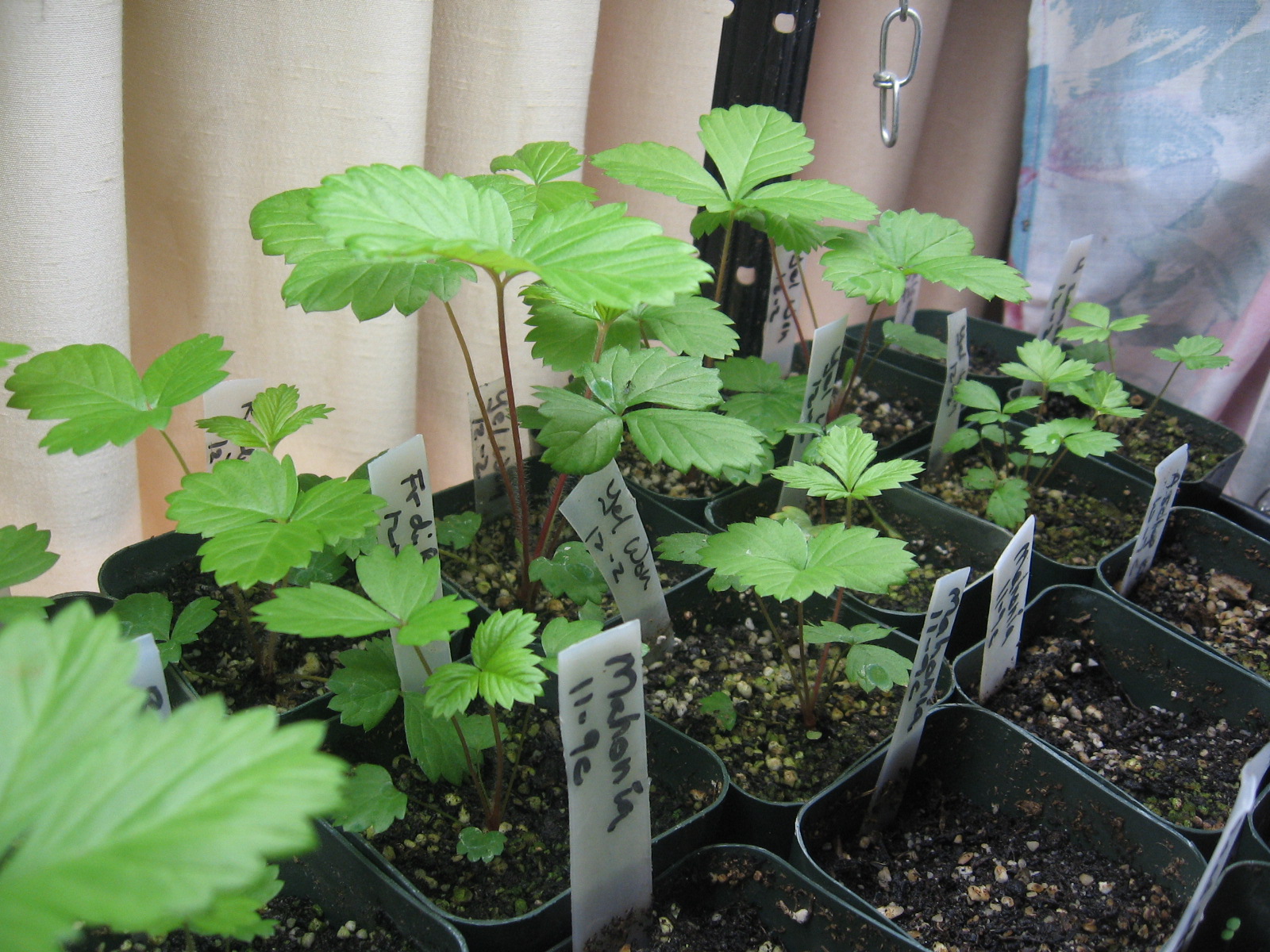
The Alpine strawberries sown in December are doing great, much bigger than ones sown in January.  They should be of a size to bloom and fruit this summer.
Well, have a nice restful remainder of the winter, and peruse those catalogs and internet sites for your plants to grow this year. 

Hannah

Wednesday, January 26, 2011

Joys of Winter Growing

Well, my seedlings from last month are getting larger.  I had to move the Butterfly Peas and Andrographis paniculata into my hydroponics set-up so they could get taller.  I clipped leaves off the lower stems of the Andrographis and pinched out the top  growth so I could dry some of the leaves and make the plants bushier.  I often grow herbs and at some point they die without my benefitting from their growth so I'm trying to actually use some. 
The Culantro, Eryngium foetidum, which has a flavor like Cilantro but is not related, is widely used in Mexico and Central America.  It is doing well and has been used in cooking a little so far.  The 6 varieties of Alpine Strawberries are coming along nicely and should be able to bloom and start bearing fruit sometime during the next summer.

In addition, I have some seedlings from seeds sown in October and  kept in the refrigerator until earlier this month.  The bottom right seedlings in the photo above are Hibiscus lasiocarpus.   Some Purple Milkweed, Asclepias purpurascens, came up as well.  And the very exciting Mertensia virginica, a Bluebell native to the eastern United States, has a single seedling up.  I failed to germinate any last year so it seems like quite an achievement.   Most pots are still sitting there with no growth, though.

More pots are in the refrigerator, among them some seeds that got temporarily mislaid that I found this week, all with edible berries, Rhus trilobata, Rhus aromatica, and Berberis fendleri, which High Country Gardens describes as tasting like sour cherries.  The rest are some new natives I'm attempting to grow, Houstonia rubra- very fragrant, Eriogonum ovalifolium, Asclepias asperula, Aquilegia formosa- a lovely red and yellow native columbine, and Agastache cusicki, a native licorice mint that needs chilling.

Under lights I'm starting more Agastaches- cana, aurantiaca, occidentalis, and rupestris.  These are very popular with bees and butterflies, and have fragrant foliage like peppermints and spearmints which are mostly non-native, but tend toward the anise and lemony fragrances.  They can also be used for flavoring dishes and dried for teas.  Some are starting to sprout at about 8 days after sowing.  I also sowed more strawberries, native Rudbeckia fulgida Goldsturm, and a lot of Dianthus superbus, the Fringed Pink, which has edible uses and is very fragrant.


I like to start some seeds by putting them in small ziplock bags from Michael's, with a piece of damp paper towel, so there is not as much loss as those started in pots.  Tomatoes, squash, and cucumbers do especially well like this.  Old seeds that failed to grow for me for several years in peat pots started this way.  I wait until the root has grown out a cm. or more then plant the seed in planting mix with a compost, peat moss, and perlite, which I heat in the microwave before planting to hopefully kill damping off fungus and fungus gnats.  So far I sprouted a bunch of Cardoon, and just started several eggplants.  Next will be some peppers and a few tomatoes, though after last year with so much cold weather in June and July, and consequent very late and poor tomato crops, I'm not growing many tomatoes this year.  I do hope to have good crops of beans, greens, cucumbers, and squash though, which did not seem very affected by the cool weather.

So, jump in and grow something under lights, it's fun to have only fungus gnats gnawing on my plants' roots instead of voles!

Hannah

Wednesday, December 8, 2010

Growing under lights

One of my most enjoyable fall/winter activities is growing plants under lights.  There is something soothing about watching new green life emerge when so many plants outside are being frozen, withered, and burnt with wind and cold.  I have a home-made set-up of a 3-tier metal shelf unit.  I use the bottom 2 shelves for holding 2 flats each, 10x20", and hang 2 4' fluorescent fixtures from the top and middle shelves.  Evenly spaced each shelf has about 11" of growing height.  I found that 2 1/4" square rose pots fit ideally into the flats, 4 deep and 9 rows long, very little wasted space.  My current starts from a sowing in early October-
Plants on the left are Andrographis paniculata, an Indian herb and flowering plant.  http://www.thymegarden.com/site/561124/product/S1009

In the center is an alternative to Cilantro, with the same flavor but a more substantial plant which will get bigger leaves and not be bent on going to seed as quickly as possible like most Cilantro plants I have grown.  It is Eryngium foetidum.  Most Eryngium's are spiny, this one included, so I expect it to be quite substantial.  The flavor of the leaves is supposed to be more intense and stand up better to cooking.
http://www.thymegarden.com/site/561124/product/S1313

On the right is the Butterfly pea, which should have a blue flower that is used to color rice blue in
Asian cooking.


At the other extreme, here is Cilantro delfino that is even more delicate and ferny than regular Cilantro.
http://www.thymegarden.com/site/561124/product/S1311

It will be interesting to try these out a little later.

Starting plants in the fall or winter gives them a size advantage next spring and makes their bloom season start earlier.  Plants that I just sowed December 2 which have not yet sprouted are 6 varieties of Alpine Strawberries, Fragaria vesca, from The Strawberry Store.  I grew 2 varieties last year, Alexandria and Delicious, from local seed packets, and found that they started blooming and fruiting quite early, and were still blooming and fruiting at the end of the growing season, though the small but tasty berries trickle in slowly, but continuously.

The Strawberry Store
The strawberries are exciting for the grandkids to seek, too.  I will see next spring how well they do their second year, and get to try out the new ones to see what differences there are in growth, size, and taste.  The new ones will be Ali Baba, Baron Solemacher, Reine des Vallees, Ruegen, Mignonette, Yellow Wonder, and the Italian ones- Fragola di Bosco and Fragola Quattro Stagioni (Four Seasons), assuming they all grow.

The shelves really come into their own in January to May, though, when I start tomatoes, squash, cucumbers, basil, and other herbs, as well as some annuals and perennials that I want to start early.  I find them an indispensable gardening aid, and very inexpensive to set up.  They can be put in any available space and make little oases of green.

Happy Holidays!

Hannah

Wednesday, November 24, 2010

Fall blooms and colors

There are a few stalwart plants blooming now.  Some that have been reliable for several years are Asters, both novi-belgii and nova-angliai.  They add that little bit of color to the border, and I start to wonder why I haven't planted more of them.


These start growing in late summer and eventually get tall and start blooming, seemingly without any care.

Daboecia cantabrica 'Atropurpurea', Irish Heath, has been blooming and continues to bloom, with it's enchanting purple balloon flowers.

A Verbascum phoenicium started by seed last November has gotten big enough to start blooming now, focus is not very good.  The others from this sowing seem to want to wait until next year to bloom.  A Fibigia is on the left.  This is my vole-free gravel-laden bed that can grow peacefully except that lots of little weed seeds keep sprouting.

Some of those long-blooming perennials are still blooming-
Some of those great little Violas, Johnny-Jump-Ups.  Not only did they start blooming fast from seed, but then seeded arounnd some little babies that even made it to bloom by fall.  Some people don't like their invasive qualities.
A few stragglers of the Lychnis coronaria.
It doesn't seem like Fall without the thrill of those flaming leaves in reds, oranges, and yellows. I'm happy to live in a climate where the trees have a long fall to develope them, unlike Denver, Colorado where untimely fall snows turn green leaves into slushy brown ones.


This is my Aronia 'Viking'.  I harvested the berries earlier.  It is supposed to grow 6' tall but gets taller.


This is Amber Ghost Japanese Maple.  The colors became more of a flaming red later but I didn't get out to photograph it.


This is a cutleaf Weeping Japanese Maple, with some blueberries peeking out behind.  This one favors golden orange with red highlights, my other one is more a wine red.
This is
Hypericum frondosum.  It had nice coloration in fall of 2009, pictured here, but is still green today, there must not have been the right cold temperatures for it this year.  Burning bushes and maples seemed to color up fine.

Well, I'm spending a lot of time researching the native plants and some vegetables I want to grow next year.  It seems a lot of the plants in the mint family, Labiatae, that we all love to grow are non-native- lots of mints, oreganos and other herbs.  So I'm getting interested in a group of North American natives, the Agastaches.  I am looking at some that are natives and wanting to grow them next year.  I did grow one last year, Agastache foeniculum, which did make a nice little plant but it is an imported plant.  Hopefully it will bloom next year.  The Agastaches have nice aromatic foliage and can be used for tea plants, and are well-loved by hummingbirds, butterflies, and especially bees.  The flavors can be minty or can be lemon, anise, licorice, etc.  I'm excited to see how well they will do in taking ground away from the weeds and getting large.  Mints do well in that respect and when blooming are really aswarm with bees, including a lot of the smaller and native bees.  So it will be fascinating to compare them.

Well, this cold weather took everyone by surprise.  I hope the cool season greens in my deck stock tank can overweather the frozen conditions out there.  And the greens I planted in July.  I've been getting some very nice big turnips lately.

Happy Thanksgiving, my menu will feature vegetarian stir-fry with Asian squash, onions, ginger, mushrooms, Shungiku greens (Chrysanthemum coronaria), which I am contemplating growing next year, and water chestnuts; and then some oven-baked Asian eggplants with a little onion, baked to a mouth-watering deep brown perfection.

Hannah


Tuesday, October 12, 2010

Finally tomatoes

All those green tomatoes enjoying the warmth of my temporary plastic house are finally starting to ripen up.  Here is a photo of the harvest from yesterday-
Names starting at top row, left,

Legend   Sochulak  Verna's Orange Oxheart   Bloody Butcher
     
Roughwood   Nepal   Japanese Black   Plum Giant      Marvel
Golden Plum(?)               Trifele             Ukraine (1)    Striped (1)

Gogosha                      Juliet  F2                           Jetsetter F2

So I'm finally being able to simmer some tomato sauce in my crockpot, third batch this year.  It was a long wait but hopefully since this year's house is more stable than last year's, which blew over 4 times and had to be reassembled, it will keep the rain totally away and prevent late blight so the tomatoes will keep on ripening.

I have to say my favorite for fresh eating is Verna's Orange Oxheart, with few seeds, and meaty succulent flesh that has a mild intriguing fruity taste.  Sochulak has been very prolific lately and is second, with that milder taste that most pinks have.  Marvel Striped has that great fruity taste that most bicolors have, similar to Verna's Orange, but just can't compete in production.  I'm missing one I used to grow, Lucky Cross bicolor, but last year when I grew it, the seed didn't come true- instead of massive cracked yellow gems with that pinkish blush inside, I got some smallish pink pointed tomatoes- I guess it ran out of luck in the cross.  Gogosha was my biggest producer last year since the fruits are so large, but 2 plants were especially damaged by mole tunnels this year, so one is coming along but the other 2 are stunted. 

I had 3 years of large trials of 60-100 varieties a year, so this year I reduced my plants to 24 and grew my favorites, generally the most productive ones from last year.  Next year I will probably go back to a few former or perhaps even new varieties, and keep just a few of these.  Well, I am fanatical enough to be weighing my harvest daily, so I can report on yields at the end of the season, but after a bang-up fastastic season like last year, I will have to moderate my enthusiasm.

Happy harvests,

Hannah

Monday, September 27, 2010

Ahhhh, Blueberries! And don't neglect the Amazing Aronia....

My favorite bush fruit as far as taste is concerned is the Blueberry.  Burnt Ridge Nursery has a good selection.  I have quite a few that bloom in succession to keep me in blueberries from mid June until nearly frost.  Some early blueberries I like include Misty (evergreen), and one I have down as Jersey which is usually considered late.   Some midseason blueberries I like are Blueray, Sunshine Blue (evergreen) which goes on into the late season, and Berkeley and Herbert, which are both tall with lots of big berries.  Legacy (evergreen) is tall and mid-late.  The evergreen bushes have fruit with a slightly different and perhaps even more delicious taste. 

Brunswick Lowbush Blueberries make a nice groundcover on a slope and have small berries over a long period of time.


Evergreen blueberries are among my favorites.  They don't lose their leaves in the winter but they do have lovely red and orange fall color- the branches are going sideways...


Sunshine Blue, one of my favorites, can get insanely loaded with berries-


I also really like Aronia melanocarpa 'Viking'; if you look up the ORAC (Oxygen Reactive Absorbance Capacity) value of Aronia, it is amazing.

It is higher than the value for Acai, a berry that sells for high prices, but you could grow Aronia in your back yard and enjoy even higher health benefits.  The variety Nero is similar to Viking but smaller, and there is a dwarf form that is smaller still.  Of all the berries I grow, Aronia are the easiest and most productive to harvest.  My two bushes are loaded every year, and the berries are formed in clusters hanging from one stem, all berries in the cluster and on the entire bush ripening at once, unlike blueberries which must be harvested so carefully since the green berries can break off with the ripe ones, so harvesting is as simple as snapping off the clusters into a bag, then I can sit around indoors and pull the berries off the stems and put 
them into freezer bags at leisure.
 

I get enough to have them last all year and beyond.  My son convinced me to overlook the slight puckery quality of the skins and seeds, and eat them raw with yogurt or Stevia-sweetened whipping cream, so now I put them raw on our fruit salad with yogurt and have come to enjoy the raw taste and save myself the work of cooking and straining to make Stevia-sweetened gelatin out of them, which is how I used to eat them.

The American diet is lacking in antioxidants, being well below the recommended 5000 units a day, but the Aronia berries can help greatly in reaching that amount, as well as adding spices such as Cinnamon, Cloves, and Ginger to your daily diet and using raw or dried herbs such as Basil, Oregano, and Rosemary in salads and cooked foods.  All of these are fantastically high in antioxidants.  Normal wear and tear from exercise, stress, pollutants, pesticides, and poor diet can increase the reactive free radicals in the body, which do oxidative damage to cells and cause inflammation and disease, wrinkles and ageing, and are implicated in heart disease, DNA damage, diabetes, and cancer.  Antioxidants can reduce the amounts of free radicals in the body and protect the heart, joints, and cell membranes from damage.  So, before you spend your hard-earned money on some Acai or other expensive imported fruit, consider growing the native and underappreciated Aronia berry.

Hannah

© Weeding on the Wild Side, all rights reserved. Any material copied must link back to this website, http://weedingonthewildside.blogspot.com

Wednesday, September 22, 2010

Brassicas- Edible, Ornamental, Vital

Brassicas, formerly known as Cruciferae because of their 4-petalled flowers, are a very useful edible group of plants.  They encompass many edible plants like broccoli, mustard greens, cauliflower, cabbage, kale, collards, turnips, Chinese Bok Choy, and so on.  Many important oil-producing plants are in this family.  They also tend to have a pungent taste, as in the mustard greens and seeds, and cress.  Nasturtium officinale is watercress, an introduced plant, and of course regular flowering Nasturtiums are widely grown, having large seed that is very easy to germinate and edible flowers and leaves. 

But there are also other ornamental plants in this group that can also have some edible functions though little-used for that.  An example is Lunaria annua, really a biennial, which is one of those plants ideally suited to growing on the west coast of the US where there is a wet season in fall, winter, and spring and a dry season in summer.  Like many other biennials (dandelions, Forget-Me-Nots, etc), the seeds will sprout with the fall rains and grow all winter, and the plant will bloom in spring, and ripen its seeds before the dry summer weather hits.  Lunaria's name comes from the translucent central disk left in the seed pod when the outer layers are carefully removed, and makes lovely shiny round orbs reflecting light for dried arrangements.  It is also called Money Plant.  But it turns out it also has edible qualities.  The early leaves can be eaten, with a slightly hot taste, and the roots are edible before flowering.  The seeds can be ground with cold water like mustard seeds to make a mustard substitute.  Lunaria can happily self-sow every year and return dependably every spring.  It prefers partly shady spots, and while usually purple, is also found with white blooms.  The leaves are attractively heart-shaped with scalloped edges.

White Lunaria
I am growing another similar plant this year that is a perennial or biennial.  It is called Fibigia clypeata, and has fuzzy silver leaves in a basal rosette,
Fibigia rosette
then sends up bloom stalks later that have small yellow flowers, and make oval seed pods that, like Lunaria, lose the outer covers to reveal a silvery translucent inner layer.   Here they had to be tied up from flopping.

Seed pods

When saving seed from another Brassica, Arugula, I was noticing it also has a translucent inner layer, though it is small enough to not be very decorative; however, I am trying some in a small vase.  Arugula is known as a spicy salad addition to add interest to a green salad, but also makes a tasty pesto with a little bite, sauteed briefly with garlic and ground smooth in a food processor.  It is also good added raw to a pizza, or cooked briefly with pasta with added riccotta or other cheese.

Many of the Brassicas are quite cold-hardy, and can be grown in a zone 8 garden in the winter.  My experience has been that the plant needs to attain sufficient size by frost to withstand the cold temperatures, so I have a deadline of July 15 to get some planted that I want to make it through the winter.  Some good choices are Wild Red Kale, collards, over-wintering types of broccoli, and turnips, which can overwinter and make early spring greens. 

I like to cut the leaves in early spring as well as the flower buds which are similar to broccoli heads but smaller. 


Many of the Brassicas, especially the fast-maturing Chinese greens, bolt quickly in spring but will last longer in fall, and grow better in the cool fall temperatures.  Bok Choy can make nice big plants at this time of year.  I direct-sowed mustard greens, Arugula, turnips, and several kinds of Chinese greens July 12 and in one month's time they were making nice greens that were ready to pick- shown here at 6 weeks, with runner beans on the left and cucumbers on the right. 

I often just remove the outer leaves but when plants are crowded I harvest the whole plant.  The white stems are crisp and sweet.  They can be boiled, or sauteed with onions, mushrooms, and garlic.  And I belong to the Garfield School of Cooking- EVERYTHING is improved by cheese.

There are a few ornamental plants in the Brassica family that are familiar, like the Wallflower, Erysimum.  They have not persisted well for me, but I had one this spring with a delightful fragrance, and I may try them from seed next year.  Iberis or Candytuft is an annual or perennial used frequently as a ground cover or rock garden plant.  The plant is liked by pollinating insects and also has medicinal uses.  Lobularia maritima, Sweet Alyssum, is used frequently as a border plant or edging and has a sweet honey-like scent, and attracts bees and butterflies.   Matthiola, or Stock, is an annual, or sown in the fall, a biennial, noted for its sweet fragrance and pastel colors.  It is used as a bedding plant and has flowers in spikes.

There are also native wildflowers in the Brassica family.  Those found in Washington state are listed here-
http://biology.burke.washington.edu/herbarium/imagecollection.php?Genus=Arabis&Species=sparsiflora
One is Rockcress, Arabis, which comes in a variety of colors and sizes; some are used in rock gardens.  To look at the list, select Families then Brassica on the left.  Cardamine hirsuta is a common weed that shoots seeds into your face when they are ripe.  Some other Cardamines are nice ornamentals and can be eaten as a cress.  It is easy to start identifying Brassicas after looking through the entries.

One introduced Brassica that is a nasty weed is Garlic Mustard, Alliaria petiolata, on many weed lists.

The edible Brassicas that overwinter are also useful as an early spring flower for a pollen and nectar source for pollinators and beneficial insects.  I let them go to seed, even though that ties up some of my beds past the earlier planting times.  The more such plants one grows in the garden, the more beneficial insects are present to act as predators and pollinators and keep the insect population in the garden in balance.  My farmer neighbor had no apples one year but my two favorite trees (Liberty and Freedom) were loaded, even though it was raining for most of the apple blossom season.

Hannah