Search This Blog

Monday, September 27, 2010

Ahhhh, Blueberries! And don't neglect the Amazing Aronia....

My favorite bush fruit as far as taste is concerned is the Blueberry.  Burnt Ridge Nursery has a good selection.  I have quite a few that bloom in succession to keep me in blueberries from mid June until nearly frost.  Some early blueberries I like include Misty (evergreen), and one I have down as Jersey which is usually considered late.   Some midseason blueberries I like are Blueray, Sunshine Blue (evergreen) which goes on into the late season, and Berkeley and Herbert, which are both tall with lots of big berries.  Legacy (evergreen) is tall and mid-late.  The evergreen bushes have fruit with a slightly different and perhaps even more delicious taste. 

Brunswick Lowbush Blueberries make a nice groundcover on a slope and have small berries over a long period of time.


Evergreen blueberries are among my favorites.  They don't lose their leaves in the winter but they do have lovely red and orange fall color- the branches are going sideways...


Sunshine Blue, one of my favorites, can get insanely loaded with berries-


I also really like Aronia melanocarpa 'Viking'; if you look up the ORAC (Oxygen Reactive Absorbance Capacity) value of Aronia, it is amazing.

It is higher than the value for Acai, a berry that sells for high prices, but you could grow Aronia in your back yard and enjoy even higher health benefits.  The variety Nero is similar to Viking but smaller, and there is a dwarf form that is smaller still.  Of all the berries I grow, Aronia are the easiest and most productive to harvest.  My two bushes are loaded every year, and the berries are formed in clusters hanging from one stem, all berries in the cluster and on the entire bush ripening at once, unlike blueberries which must be harvested so carefully since the green berries can break off with the ripe ones, so harvesting is as simple as snapping off the clusters into a bag, then I can sit around indoors and pull the berries off the stems and put 
them into freezer bags at leisure.
 

I get enough to have them last all year and beyond.  My son convinced me to overlook the slight puckery quality of the skins and seeds, and eat them raw with yogurt or Stevia-sweetened whipping cream, so now I put them raw on our fruit salad with yogurt and have come to enjoy the raw taste and save myself the work of cooking and straining to make Stevia-sweetened gelatin out of them, which is how I used to eat them.

The American diet is lacking in antioxidants, being well below the recommended 5000 units a day, but the Aronia berries can help greatly in reaching that amount, as well as adding spices such as Cinnamon, Cloves, and Ginger to your daily diet and using raw or dried herbs such as Basil, Oregano, and Rosemary in salads and cooked foods.  All of these are fantastically high in antioxidants.  Normal wear and tear from exercise, stress, pollutants, pesticides, and poor diet can increase the reactive free radicals in the body, which do oxidative damage to cells and cause inflammation and disease, wrinkles and ageing, and are implicated in heart disease, DNA damage, diabetes, and cancer.  Antioxidants can reduce the amounts of free radicals in the body and protect the heart, joints, and cell membranes from damage.  So, before you spend your hard-earned money on some Acai or other expensive imported fruit, consider growing the native and underappreciated Aronia berry.

Hannah

© Weeding on the Wild Side, all rights reserved. Any material copied must link back to this website, http://weedingonthewildside.blogspot.com

Wednesday, September 22, 2010

Brassicas- Edible, Ornamental, Vital

Brassicas, formerly known as Cruciferae because of their 4-petalled flowers, are a very useful edible group of plants.  They encompass many edible plants like broccoli, mustard greens, cauliflower, cabbage, kale, collards, turnips, Chinese Bok Choy, and so on.  Many important oil-producing plants are in this family.  They also tend to have a pungent taste, as in the mustard greens and seeds, and cress.  Nasturtium officinale is watercress, an introduced plant, and of course regular flowering Nasturtiums are widely grown, having large seed that is very easy to germinate and edible flowers and leaves. 

But there are also other ornamental plants in this group that can also have some edible functions though little-used for that.  An example is Lunaria annua, really a biennial, which is one of those plants ideally suited to growing on the west coast of the US where there is a wet season in fall, winter, and spring and a dry season in summer.  Like many other biennials (dandelions, Forget-Me-Nots, etc), the seeds will sprout with the fall rains and grow all winter, and the plant will bloom in spring, and ripen its seeds before the dry summer weather hits.  Lunaria's name comes from the translucent central disk left in the seed pod when the outer layers are carefully removed, and makes lovely shiny round orbs reflecting light for dried arrangements.  It is also called Money Plant.  But it turns out it also has edible qualities.  The early leaves can be eaten, with a slightly hot taste, and the roots are edible before flowering.  The seeds can be ground with cold water like mustard seeds to make a mustard substitute.  Lunaria can happily self-sow every year and return dependably every spring.  It prefers partly shady spots, and while usually purple, is also found with white blooms.  The leaves are attractively heart-shaped with scalloped edges.

White Lunaria
I am growing another similar plant this year that is a perennial or biennial.  It is called Fibigia clypeata, and has fuzzy silver leaves in a basal rosette,
Fibigia rosette
then sends up bloom stalks later that have small yellow flowers, and make oval seed pods that, like Lunaria, lose the outer covers to reveal a silvery translucent inner layer.   Here they had to be tied up from flopping.

Seed pods

When saving seed from another Brassica, Arugula, I was noticing it also has a translucent inner layer, though it is small enough to not be very decorative; however, I am trying some in a small vase.  Arugula is known as a spicy salad addition to add interest to a green salad, but also makes a tasty pesto with a little bite, sauteed briefly with garlic and ground smooth in a food processor.  It is also good added raw to a pizza, or cooked briefly with pasta with added riccotta or other cheese.

Many of the Brassicas are quite cold-hardy, and can be grown in a zone 8 garden in the winter.  My experience has been that the plant needs to attain sufficient size by frost to withstand the cold temperatures, so I have a deadline of July 15 to get some planted that I want to make it through the winter.  Some good choices are Wild Red Kale, collards, over-wintering types of broccoli, and turnips, which can overwinter and make early spring greens. 

I like to cut the leaves in early spring as well as the flower buds which are similar to broccoli heads but smaller. 


Many of the Brassicas, especially the fast-maturing Chinese greens, bolt quickly in spring but will last longer in fall, and grow better in the cool fall temperatures.  Bok Choy can make nice big plants at this time of year.  I direct-sowed mustard greens, Arugula, turnips, and several kinds of Chinese greens July 12 and in one month's time they were making nice greens that were ready to pick- shown here at 6 weeks, with runner beans on the left and cucumbers on the right. 

I often just remove the outer leaves but when plants are crowded I harvest the whole plant.  The white stems are crisp and sweet.  They can be boiled, or sauteed with onions, mushrooms, and garlic.  And I belong to the Garfield School of Cooking- EVERYTHING is improved by cheese.

There are a few ornamental plants in the Brassica family that are familiar, like the Wallflower, Erysimum.  They have not persisted well for me, but I had one this spring with a delightful fragrance, and I may try them from seed next year.  Iberis or Candytuft is an annual or perennial used frequently as a ground cover or rock garden plant.  The plant is liked by pollinating insects and also has medicinal uses.  Lobularia maritima, Sweet Alyssum, is used frequently as a border plant or edging and has a sweet honey-like scent, and attracts bees and butterflies.   Matthiola, or Stock, is an annual, or sown in the fall, a biennial, noted for its sweet fragrance and pastel colors.  It is used as a bedding plant and has flowers in spikes.

There are also native wildflowers in the Brassica family.  Those found in Washington state are listed here-
http://biology.burke.washington.edu/herbarium/imagecollection.php?Genus=Arabis&Species=sparsiflora
One is Rockcress, Arabis, which comes in a variety of colors and sizes; some are used in rock gardens.  To look at the list, select Families then Brassica on the left.  Cardamine hirsuta is a common weed that shoots seeds into your face when they are ripe.  Some other Cardamines are nice ornamentals and can be eaten as a cress.  It is easy to start identifying Brassicas after looking through the entries.

One introduced Brassica that is a nasty weed is Garlic Mustard, Alliaria petiolata, on many weed lists.

The edible Brassicas that overwinter are also useful as an early spring flower for a pollen and nectar source for pollinators and beneficial insects.  I let them go to seed, even though that ties up some of my beds past the earlier planting times.  The more such plants one grows in the garden, the more beneficial insects are present to act as predators and pollinators and keep the insect population in the garden in balance.  My farmer neighbor had no apples one year but my two favorite trees (Liberty and Freedom) were loaded, even though it was raining for most of the apple blossom season.

Hannah

Wednesday, September 8, 2010

Tragedy Strikes in the Squash Patch

Well, what can I say.  Mature squash plants are lying there turning yellow and shriveling up, their stems bitten through at the ground.  Win a few, lose a few.  Sob.

There can't have been much nutrition in the few inches of stalk eaten, it must have been more like, "I don't like this thing growing here in my space!"  At least I have the satisfaction of seeing a few vole carcasses or even just the heads lying around left by the cats.  I'm not a cat lover but appreciate them when I see their efforts.  My special revenge is to put the corpses in the tops of vole or mole holes to make it particularly unappetizing for them to use that run again. 

The cats do seem to be leaving the garter snakes alone now, so I can see some in parts of the yard that seem to live there now.  I call them fruit flavors depending on the colors of the stripes on their backs, like "Strawberry Kiwi", "Raspberry", or "Lemon".  Snakes and other helpful wildlife can be encouraged and protected from cats by creating some shelters around the yard, like strategically placed piles of branches or brush, tarps laid out on the ground, or deep ground covers.  I even was surprised to see a lizard again after several years of not seeing any, a Gerrhonotus or Alligator lizard.

Here's what the squash, mostly Crookneck, which are divine eating, very nutty taste and excellent texture when picked young, look like when growing happily.  I have had very good success with the variety sold by Lily Miller.

For some reason the voles went after all 3 of my winter squash which were vigorously climbing some trellis and setting on fruits-

At least my endeavors to protect my pole beans are working in part, see my other post on voles-
http://weedingonthewildside.blogspot.com/2010_08_01_archive.html
  Here is a happy combination of Insuk's Wang Kong (IWK) Runner beans and Grandma Robert's Purple Pole beans (GRPP), which are the fastest pole beans to produce that I grow, they were selected for late planting.

The hummingbirds really like the red flowers, and runner beans are more adapted to cool summers so will start producing earlier and keep on going later than regular pole beans.  I'm experimenting in another bed with interplanting GRPP with Gopher Purge, Euphorbia lathyrus.  I didn't wrap the stems with foil but none have as yet been bitten off.    However this bed did not grow beans last year, though it did have cucumbers in that space.


The beans have done well so far, I picked 41 oz today from the 25' here and the 10' in the photo above with IWK.


More vole damage, they hollowed out a Lemon cucumber but strangely left a green cucumber right next to it alone.

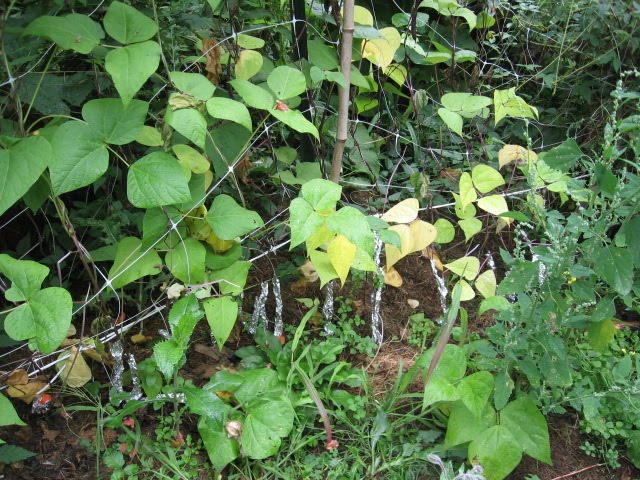
They also don't seem to bother mustard greens at all.  Greens must be planted before July 15 here to get big enough to live through the winter, but will get big enough to eat now in only a month from sowing, like the ones shown here.  Beans I thought were bush beans turned out to be pole beans and required some bamboo poles to climb on, but even in the tangle of greens many of the pole beans have been nipped off by the voles and are wilting.


Here are the mustard greens planted out around July 12 and now large enough to pick,

Runner beans are on the left, greens with some pole beans in the middle, and a really nice cucumber, NC (North Carolina) Pickle, on the right, which made a lot of vines and has really been pumping them out.  I like to get the cucumbers up off the ground on a cattle panel or in this case some supplemental bamboo poles as well.


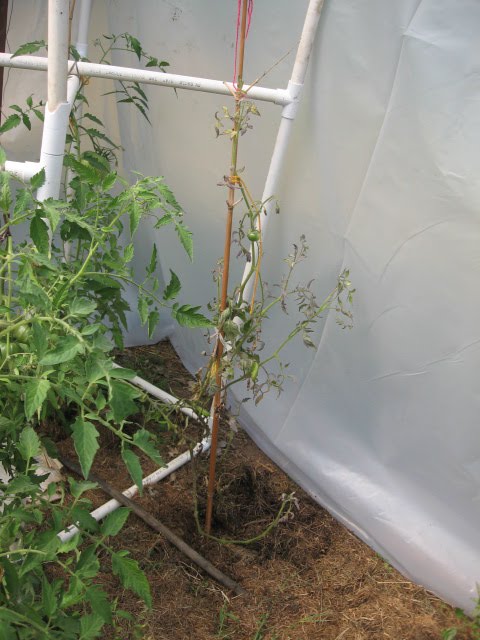
There is also damage in the tomatoes.  In this case I think it is mostly from the moles who love it when I dig a planting hole and put manure in it; the soil is so lovely and loose, and worms must like the manure, so they tunnel up under many or most of my tomatoes.  Not many of the plants actually seem to suffer, but some whose roots are damaged or exposed to too much air underground do-
Poor shriveled Gogosha, the sadder because it was my best yielder last year.  When I go down the row and water with a strong hose pressure, the water makes a rushing sound down the holes like it is going over a waterfall into China!


Legend, from seed by Ed Hume, is doing well and even getting ripe.  It is supposed to be resistant to late blight, and has a nice blemish-free round tomato with a sprightly flavor.

Well, the battle continues.  I am planning to try some sneaky home remedies on the voles soon, I don't know if I will be able to tell if they work.  We got record rainfall today, the most rain in one hour EVER (I assume in recorded weather data keeping).   It didn't seem so much to me, I grew up in Houston.  If it rained a lot there, people rowed boats around on the streets and the crawdads in the 10' roadside drainage ditches were happy.  My recurring childhood nightmare was to get up to sharpen my pencil in my flooded schoolroom and step inadvertently into the open mouth of an alligator, brought on by my brother keeping a snapping turtle in his room.;-)   I am so happy to have my nice toasty tomato house up to keep them high and dry.;-)  See-
I eliminated the sagging this year by putting welded wire and chicken wire in the roof to support the plastic.  And with so many green tomatoes, the baskets full of tomatoes I normally get may soon be here, and the smell of tomato sauce simmering on the stove or in the crock pot.

Hannah

Saturday, September 4, 2010

Chilly Green Tomatoes Get a House

This year has been good for vegetable production for the most part, especially the squash, cucumbers, beans, and mustard greens.  But tomatoes have been very slow because of the long period of cold wet weather in June and July.  So I just finished a plastic hot house to warm them up.  I start my tomatoes under lights in January, using small ziplock bags with a piece of wet paper towel inside to start the seeds, which must then be taken out and transplanted to a small pot after they have sprouted and grown a root.  I use Anderson Die and Manufacturing Co. rose pots, which are 2 1/4" squares and 3 1/4" tall.  They are nice because they fit 4 x 9 into the common black plastic flats sold at Fred Meyer and other outlets.  The flats fit 2 per shelf on metal shelves available at hardware stores, and a three-shelf unit can hold 2 shelves of flats with 4' fluorescent fixtures suspended from the shelves above = 144 pots.

Tomato seedlings in Rose pots

The chains to the right come with the fluorescent fixtures and can be hooked into holes in the vertical posts of the shelves.  I make some plant markers out of cut up milk cartons.  After the plants reach the lights, at about 11" tall, they are ready to plant outdoors.  I  checked 30 year weather reports and found that lows are typically above 32* F around April 15, but only 2-3 degrees lower on April 1, so I start planting out in early April under TunLCovers I have bought from the manufacturer or from Gurney's.  They are double-walled and have kept tomatoes safe through snows and frosts.  They are 18" tall and wide with metal ribs that push into the ground.


TunLCovers drying soil

The really great thing about the tunnels is that they keep the soil dry underneath them, so I put then out a couple of weeks before time to plant and use them to dry the ground enough to plant, since working wet soil is destructive to soil structure. So I just have to wait for a day with a few hours of dry weather to get some planting done. 


Tomatoes, planted 2 rows on the left, one on the right because of space constraints, T-posts already present.

Since I have problems with moles liking freshly dug earth to come up to the surface next to the plants, I loosen up only enough soil to plant the tomato, around a shovel depth and 12" or so wide.   I put rabbit manure in the bottom of the hole along with some lava rock to make it a little scratchy for the moles and voles to dig there, and then mix in some compost, glacial rock dust, lime, and mycorrhizal fungi with the soil when planting.   I try to get the plant as deep as possible in the hole since tomatoes will root all along the stem where covered with soil.  For several years I have been trialing lots of tomatoes, like 60-90 varieties per year of mostly heirlooms, so I have planted them 18" apart in the row and double rows 18" apart to get lots of plants in.   I then run wires down the rows from T-posts with crosspieces to make 2 rows per post.  I space out tomato cages at intervals to help support the wires so they don't sag, and at the higher second level I use bamboo stakes, usually more than one per plant, which are also fastened to the wire and help hold it up.  I then have to spend time tying up tomato vines to the bamboo and wires.

But this year I decided to plant fewer tomatoes, my best 13 varieties from last year's trials, and have them 36" apart.  I also tried building tomato cages out of PVC pipe, then decided to build a roof structure to hold up plastic film to make a temporary warm structure to hopefully boost production and prevent late blight by keeping rain off the tomatoes, since rain splashes mold spores up on the plants and gets it started.  I got the ribs done-


Then rain was expected the next day so I got the plastic on as well, and after experiencing a lot of problems last year with it blowing off since it was put on lengthwise, 10' wide, and didn't come down all the way, I ran it across this year and all the way to the ground so the wind can't get under it as well.


Finished tomato house

It will take some storms and high winds to see how it does this year.  It should keep the temperature much warmer at night and hopefully speed ripening, which has been very slow this year because of the cold spring and the cold night tempertures.  Verna's Orange Oxheart did yield 14 oz, 10 oz, and 10 oz tomatoes for earliest large tomatoes.  Other tomatoes I'm growing are Bloody Butcher, Gogosha, Japanese Black Trifele, Jetsetter, Juliet F2, Legend, Marvel Striped, Nepal, NoID round one I call Perfect 10, Plum Giant Ukraine, Roughwood Gold, and Sochulak.  There are lots of green tomatoes so hopefully soon enough for some tomato sauce.


From the top clockwise- Gogosha, Jetsetter, Black Sea Man, Herman's Yellow, Nepal, center Verna's Orange Oxheart.  Happy Labor Day!

Hannah


Tuesday, August 3, 2010

Voles: Fight to the Finish

Voles, in case you are one of the people who have never heard of these rodents, are New World (Western Hemisphere where we live, N. and S. America) rodents related to Lemmings.  I seem to have a large population in my yard.  If I put a board or cardboard on the ground and come back after a few weeks, the ground underneath will be covered with surface runs, and sometimes with a nest.  Voles like to move into old mole holes, but do not make mounds at entrances to burrows like moles do.  They also are different in what they eat; moles eat earthworms and grubs, but voles like plants, and tree roots- I figured that one out after a full-grown Gala apple tree, loaded with fruit, fell over from lack of root support.... 

A vole will have a plumper body and rounder face than an Old World rat or mice (from Eur-Asia, or Africa), and will have a shorter tail only half the length of its body.  I have caught a few in just a rat or mouse trap with peanut butter, but generally a used trap catches no voles.  Voles don't bother all vegetable crops, they leave tomatoes, squash, cucumbers, and most greens alone, but they can be very destructive when it comes to beans, especially pole beans.  Once they get used to the plants and decide they like the taste, the war begins.  They will eat the seeds, the sprouts, come up underneath and eat the roots, and most disgusting, nip off the vine as it makes its way up the trellis, even sometimes to the top, covered with blooms.   Arrrrgh.

So my battle plan has involved first getting the seed sprouted and growing.   Soaking them in water overnight and then rinsing and draining them several times a day until the root starts to grow, helps speed up the growth of the bean.  What I have been doing when planting is to dig only enough hole or trench to plant the seed or seeds so as not to loosen up the soil for the voles.  I then sprinkle cayenne pepper on each seed and put a 4" or more galvanized nail into the ground next to the seed, *warning* don't copy this at home since stepping on a nail could give you a nasty wound and give tetanus bacteria an entry into it.  After planting I usually pick some leafy weeds and lay them over the bean rows, then cover with a strip of chicken wire, to discourage birds from digging up seeds before they sprout.  I remove the wire after the sprouts are up.  I have trouble finding all the nails at the end of the season, I think some fall through into vole tunnels and disappear.  They do prevent the vole from coming up under the plant and nipping off the roots and stem, so they have to approach from on top of the ground.  But then stage 2 of the battle occurs, they nip off the lower leaves and can nip the stalk in two.  My approach to this is to cut strips of aluminum foil, around 9" long and cut into 4 pieces lengthwise.  I then wrap each stem with a strip of foil, starting at the ground lengthwise, and folding it around, then folding it again to enclose the stem, trying to leave out any leaves remaining.  The voles apparently can't stand on tippy-toe with their stocky little bodies, and don't like the taste of aluminum.;-)


This is a trellis I built last year, designed for Scarlet Runner Beans, Phaseolus coccineus. These have red flowers, much appreciated by hummingbirds. The hummer would perch on the trellis, looking very territorial, laying claim to all the flowers as his personal property.  This year it is covered skimpily by a couple of runner beans from Tompson & Morgan Seeds, Polestar and Wisley's Magic.

I generally make trellises with T-posts, stringing netting between them, held up at the top with a multi-strand wire cable coated with plastic, weaving it in and out of the top squares of the netting.  I have tried nylon netting made by crocheting a nylon string, or polyproplene monofilament, as in the photo above.  The nylon netting has lasted me several years, but the polypropylene from Johnny's Select Seeds had some broken filaments after one season, though I am not sure what caused it, mechanical injury or animals.  I repaired it by running yarn along the good filaments and across holes to replace the bad ones.  I can go cut a few 8' bamboo poles to place at intervals to give the netting more support, but in the photo I used tubular posts covered with green plastic.  One bed made in a rectangular shape has had more stability and less tendency for the posts to lean over from the weight of the vines.  The trellis pictured was used for Insuk's Wang Kong runner beans last year, and grew fabulously.  The flowers are there in this September photo but may be hard to see. 

Some other trellis ideas by the great home gardeners on GardenWeb can be seen at-


GardenWeb has lots of forums on different plant groups, areas, etc. and is open to read but to post you must join; it is free, and there is a lot of information, but there are lots of ads to pay for it.

I got most of the bean stems wrapped with aluminum foil today, so I hope to halt the nipping of vines which had started recently.  Last year I tried the Scarlet Runner Beans (SRB), a different species than the regular pole beans, after reading on GardenWeb that SRB likes cool summers like mine in the Pacific Northwest, which is very similar to Great Britain where they are about the only beans grown, and many varieties have been developed.  I had grown them previously but didn't appreciate them sufficiently because I probably picked them a little too big and they can get tough in the larger sizes after the seeds have developed, though they are good then shelled.  Last year I attempted to pick them at a smaller size and did find them more tender, and liked the taste and the firm texture.  This year I am growing 4 kinds to compare, as well as some regular pole beans- Uncle Steve's, an heirloom bean; Super Marconi, a wide Romano type pole bean; and as an afterthought, I decided to try some Grandma Robert's Purple Pole beans, another heirloom, since they are the fastest to develope and it was getting late to plant pole beans.  The SRB's have been blooming earlier than the pole beans, and will doubtless develope some beans sooner, as they can do better in the cooler temperatures.  Thompson and Morgan have several varieties from which to choose.  Can't wait!

Hannah

Saturday, July 31, 2010

Succession of bloom: Columbines in the Hobbit Garden

I'm late with this post since it's no longer spring and the Columbines have ceased to bloom.  June turned out to be a series of trips resulting in weeds going to seed in epic proportions.  So I've been trying to remove seedheads and get them out of the yard before I have 7 years of bad weed luck. 

Anyway, I like to have a succession of bloom in spring, starting with Hellebores, Pulmonaria, early Narcissus, Muscari, and species tulips, like the very dependable red Tulipa praestans unicum.


Muscari neglectum is a good naturalizer that makes a clump-


Another early bloomer that makes quite a show is Vinca minor, here the variegated form adds a little sparkle to a shady place.


A few weeks later, the Anemone nemerosas make charming clumps.


But as charming as all these are in the spring, when the Columbines start to bloom in a area that was supposed to be a rose garden, they achieve an atmosphere of aerie faerie abandon that is worthy of a hobbit garden.


These are all grown from seed.  The double form is delightfully fluted and ruffled, like little pinafores. 


This is the single dwarf form, which comes also in several colors.  This is as close to red as they get.  The columbine foliage is also delightful, and persists all year.  The chartreuse mound behind it is a nice Oregano grown from seed.


Some of the single blooms are bicolored, as well.  The one drawback is that the tall seed heads must be cut off later.  I save up the seed to sprinkle on unruly areas of the yard to get more Columbines started.

An update on some of my earlier photos- the Lychnis coronaria is now tall and blooming.

The driveway bed which has a lot of Rubus calycinoides ground cover and was cleared last winter from a large Mugho Pine shrub, is doing well with a mixed group of Rudbeckia from Thompson and Morgan.


The Coreopsis tinctoria started blooming early and looks nice in a basket but is rather small to have much impact in the bed above.   These seeds came from J.L. Hudson, Seedsman, which has a large variety of seeds but not many that are natives.


Some Achillea millefolium Colorado, and Anchusa Azurea may eventually bloom.


Fireweed, Chamerion (formerly Epilobium) angustfolium, is one of those native wildflowers that can take care of itself.  I was surprised to see a hummingbird sipping from its blossoms as well.  I usually remove the seed heads to restrict reseeding.  Another reliable bloomer that takes care of itself but has not reseeded for me is Stachys betonica, unfortunately not a native.


Well, back to weeding.  Here is a bed that was partly planted in June and more plants added this week; it will take a while for them to fill in.  Happy growing!

Saturday, May 15, 2010

Bodacious, boisterous but incorrigible Borages

I've been slowly realizing how many members of the Borage family, now called the Hydrophyllaceae, have come to grow in my yard, and to succeed, many fantastically.  My favorite ground cover, Symphytum grandiflorum, pictured in my introductory post, is one such.  A similar plant is regular Comfrey, which is tall with purple flowers in spring.  The fuzzy leaves are supposed to make good animal feed and good green stuff to hasten decomposition and boost mineral content of compost piles.  The Comfreys fall into the incorrigible category, don't even think about trying to get rid of them.

The annual herb Borage self-sows very easily, and is coming up now.  It can be chopped finely and eaten in salads, with a cooling cucumber-like taste, and also has an edible blue flower that is a colorful addition to a salad.   The young leaves can also be cooked like spinach, or used to flavor other dishes.  The stems can be peeled and eaten like celery.  In ancient times, the herb was thought to increase courage and was used before battle to flavor wine by the Celts.  Borage is also an excellent plant for attracting bees to the garden.  I like to let it volunteer in my squash and cucumber beds to draw the bees.  It can become an imposing 3-5 foot plant studded with blue star flowers. 

Then there are the wonderful Pulmonarias, Lungworts.  These plants have a wonderful variety of leaf shapes and colors, most variations on a theme of dark fuzzy green swirled or spotted with varying amounts of silver. 

Roy Davidson
They do best in shade or part shade, where they don't need much water in summer, but in the hot summer sun they can wilt dramatically.  They make an early spring show of various colors, from a deep cobalt blue,

Excalibur
fading pink (deep colors not photographing true to nature), to various shades of purple, light blue, pink,

David Ward
peach, and white.  So a few different plants can add quite a variety of attractive spring blooms, and the plants also self-sow sparingly, so the plants slowly increase in beds and can hybridize delightfully to create your own special blends of flower and leaf colors.

Mrs. Moon
Another fantastic plant is Brunnera macrophylla, Bigleaf Brunnera or Siberian Bugloss.  It has lovely heart-shaped leaves, and tiny forget-me-not type blue flowers in spring, in abundant sprays.
Brunnera
There is also a silvery form, 'Jack Frost', that I don't have, and a variegated form with added allure-
Brunnera  'Variegata'
These plants do best in shade or part shade, and will gently self-sow.

Then we get to the biennnial forget-me-nots, which will self-sow with a vengeance, Myosotis, I was given them so best guess is arvensis.  They will come up with reckless abandon, blanketing large areas.  This looks really beautiful for a while, though it seems mildew inevitably appears on the scene as the flowers start going to seed, when they become a pain to rip out.  But for a while they are a blue cloud of loveliness.
 
Myosotis
Various nurseries have developed pink, white, or varied blooms, and there are also annual forms.   There is also the perennial forget-me-not Omphalodes, with larger flowers and entrancing variations like 'Starry Eyes', blue petals lined with white edges.  These are lovely but so delicate they have not persisted in my garden.  There is even a native tiny forget-me-not, Myosotis laxa, only 4-16" tall and with tiny blue flowers fading yellow, in the famed spiral Borage scorpiod inflorescence toward the left corner, and fuzzy leaves.  Blogspot keeps turning this photo on its ear, arghh.  The tiny flowers are a deeper blue/yellow than pictured.  Cute.
Myosotis laxa
Another tiny native Borage that makes a vine with tiny oakleaf-like incised leaves, is Nemophila parviflora, with tiny white cup-shaped blossoms
Nemophila parviflora
But a woodland ground  cover of a larger size can also be found, capable of carpeting expanses of cool woodland floors, Hydrophyllum tenuipes, the Pacific waterleaf, here show with flower buds in a fuzzy ball.

Hydrophyllum tenuipes
Finally, there is the largest of the native Borages in my yard, which can attain 3-5' in height, crowned with one-sided coiled inflorescences that are intensely fuzzy with inconspicuous greenish flowers with protruding stamens.  They won't be in bloom for a while, this is the plant at this date, if you saw the bloom you would understand the common name, the Shade Scorpionweed.

Phacelia nemoralis
  I have a couple more Borage family members that I'm growing from seed but haven't seen blooming yet, Anchusa azurea, and Alkanet officinale which get 3-4' tall and 2' tall, with more blue flowers.  I'm also growing the house plant Heliotrope from seed, they are doing well so far but far from blooming.

So, a successful group of plants, very useful in the War on Weeds.  And a source of a rare garden color, true blue.  One of my pet peeves, have you noticed how often plant breeders try to breed the color blue into plants that just don't have the genetic potential for the color, like daylilies, and call various shades of magenta "blue" as though all of us are colorblind.  LOL

Hannah

© Weeding on the Wild Side, all rights reserved. Any material copied must link back to this website, http://weedingonthewildside.blogspot.com