Search This Blog

Sunday, April 3, 2011

Will Fear Keep You From Growing this Awesome Garden Workhorse?

So many gardeners avoid running bamboo because of its reputation for being able to send runners a long way underground and pop up to create massive stands of inpenetrable canes.   I personally love my running bamboo, it returns so much useful material for such a small investment.   I can't say that I have seen runners travel very far either.  That may depend on water availability and soil conditions, though.   Here in the PNW there is no summer rain so the ground is quite dry and may suppress formation of runners in my largely unirrigated garden.  None of my bamboos get supplemental water at all.  My main bamboo for canes at present is Phyllostachys nuda, on the right, also known as a source of edible shoots.  I haven't tried them.
On the left but younger is P. vivax and P. nigra 'Henon', one set behind the other.  Someday they may make canes worthy of their reputation.  Can't wait.  I have an older larger clump of P. nuda (shown below 4 years ago) that has provided me 10+ years with literally hundreds of tomato stakes and 8' tall canes used to add height to my welded wire deer fences, with wire stretched between the canes at various levels.  It is incredibly beautiful in the winter when all the surrounding deciduous trees are bare and ugly.

Sasaella kurilensis 'Shimofuri', which has pinstripe variegation, makes an attractive accent in a shady place and spreads very slowly, at about 6' tall-

Finally, Sasaella masamuneana 'Albostriata', known as Sasa Masa, is useful as an evergreen hedge or backdrop, at about 4' tall-

They don't come any more low-maintenance than that.  This is 27' of plant material all from one gallon pot.

I have to comment also that my one clumping Fountain bamboo, Fargesia nitida, flowered one year.  For those of you who are unfamiliar with what happens when a bamboo flowers, the plant considers that it has achieved its life purpose and dies.  So... no more Fountain bamboo.

So, for my most practical plant collection, the award goes to (drumroll) running bamboo!

Hannah

Friday, April 1, 2011

Chopping off the Gorgon's Head

This is the Gorgon, a Wisteria that had been a deck-eater and was moved to a place in the lawn.  She would not refrain from trying to take over the yard so I finally decided to permanently remove her, or as permanently as it is possible to remove a really rampant vine.  She did flower but only briefly in the spring, which was not worth having to cut her back every fall.  If you want to see what one can grow into, visit the Bishop's Close garden in Portland, OR to see a very large Wisteria forming an outdoor room on a very large iron trellis.
First I used a lopper on all the branches, leaving a twisted trunk system.
I then tried one of my favorite tools, a folding saw, which has been invaluable in pruning off 2-3" branches high in apple trees.  It is hard to do branches close to ground and twisted around, so I then resorted to a racheting lopper and then an axe, and finally got it cut off but left some stumps that will need further work in order to be able to mow the area again.  We will regain car access to that part of the lawn, which makes a loop around our pump house and storage building.  Here are my tools-
The next step will be to run the branches through our chipper- free mulch!  Mowing will take care of all the little Wisteria vines that will be popping up in the future.

Today I also managed to get the clean-up started on my front door blog photo-feature bed.  First I removed some dead branches and twigs from the weeping cutleaf Japanese Maple.   I pruned the dead growth off the tree peonies.   I removed some dead geranium growth from last year.  Then I cut off the Miscanthus grass clumps with my folding saw.  It has an advantage over a lopper or pruner since I can grab a whole clump and start sawing away, and don't have to do multiple cuts to reach each grass stalk.  Usually this should be done in February but it was difficult since it was so cold and wet, but I didn't see much in the way of new growth yet anyway.   This bed was supposed to be a variegated bed.  The grass is also known as Zebra grass since it has stripes across the blades.  Variegated Hebe speciosa variegata proved too tender for here and was lost; a shame since it was a beautiful plant.  A variegated Wallflower also did not last.  Lonicera nitida Lemon Beauty is still there.  The wonderful species Tulipa praestans unicum makes a dependable appearance now with variegated leaves and gorgeous red flowers.  Vinca major 'Variegata' is nicely variegated but can be quite the garden thug.  I have to balance that off with its ability to overcome weeds.  I prefer the Vinca minor 'Illumination' which stays very low to the ground, and is very lovely in bloom, pictured in my July 31, 2010 post, along with Tulipa praestans unicum.
The large brownish clump behind the moss-covered tea house is my variegated Daphne x transatlantica 'Summer Ice', which has a narrow cream edge around the leaves.   That clump had the leaves go brown in winter but a smaller bush (shown below) by the front porch stayed green.  Both have lots of little buds coming on, and keep on blooming during the summer unlike D. odora.
Another Daphne with purple flowers which makes a very neat small mound is D. 'Lawrence Crocker'.
Daphnes have been one of my favorite genuses to collect, though only 4 of 8 are still alive, #4 being D. tangutica, a nice larger clump with pink/white flowers.

Favorite perennial to collect is probably Pulmonaria, which are now coming into their full glory.  In addition to having a wide range of flower colors, leaf shapes, and silvery spots and patterns, they have the ability to self-sow, and hybridize to yield all sorts of new adorable seedlings.  Cute, huh?
And out of 14 varieties, I've only lost one to some kind of root rot- Margery Fish.  They like cool shade best, and can positively languish in a hot dry location.
The ultimate in silvery durable charm.  More photos of Pulmonarias can be seen in my May 15, 2010 post on the Borage family.

Hannah

Sunday, March 27, 2011

Ahhh... Those Spring Garden Shows

Everyone seems to be enjoying those spring garden shows already, but the local one is still a month away, so I decided to get out my photos from last year and relive those fragrant fresh garden mulched, dreamily lit, dreamily designed moments.  A little anticipation never hurts.

If I had an unlimited budget and the desire to create an inspirational and luxurious outdoor living space for wonderful dinners, entertainment, and relaxation in a romantic setting, it might look a little like this- start with a magnificent superstructure-
 Add a large video screen and comfortable seating, as well as a well-equipped outdoor kitchen and barbeque-
Some natural rocks and subtle lighting enhance the impression of being alone in an exotic nocturnal landscape.

Some exhibits at the garden show incorporated metal sculpture-
A low maintenance landscape giving a natural feel to the garden for the nature lover...

Or reminders of our local wildlife treasures and volcanic terrain.

Stone water features can transport us to fountains and waterfalls,
Or we can add hardy palms and desert features for those who miss warmer climates.
What I considered the most impressive new plant is this symmetrical and soft-foliaged Mahonia 'soft caress', used in some landscapes with great effect.
Hardscaping with flagstones, low walls that could be used for seating, low maintenance plantings, bright or subtle lighting, and structures with drapes for privacy can enhance night time entertainment.

My appetite is whetted for this year's garden show soon, what inspires you?

Hannah

Spring Cleaning and Bed Preparation

Spring has finally arrived, at least on the calendar!  We have had an unusually cold March in the PNW, none of the usual days above 60* F.  It has also been rainy and grim.  So it's been nice to have at least a little sun and slightly dry weather to get out and begin the garden clean-up for spring planting.  Here for example is my signature view after winter's devastations and before cutting back dead material-
The wonderful ground cover Ceanothus gloriosus Point Reyes has spread well across the path from the deciduous cutleaf weeping Japanese Maple, and the early-blooming Hellebores, Muscari, and Primula are coming along behind it.
The most pressing chores are to trim off dead growth on the two Tree Peonies, and cut the clumps of Miscanthus close to the ground before they start to grow.  A few species tulips will make their appearance before long, like the delicate ethereal T. batalinii Bright Gem-
The hardy geraniums in the bottom of the photo will also hopefully spring forth into new ground-covering glory studded with flowers like bouquets-
But since I am predominantly concerned with the edible garden, I worked on vegetable bed preparations this week.  This bed was seeded with turnips, collards, and mustards last July to yield winter greens, now ready to pick-

Bed last August

The preparation consists of laying down newspaper to kill whatever weeds might be growing in the old squash, cucumber, and bean rows, leaving the brassicas in the middle for harvest.  Next week I will place some tunnels on the paper to keep out the rain and dry out the soil for planting the crops for this year, bush beans and mostly determinate tomatoes, along with peppers and eggplants, to provide some poisonous roots among the beans to hopefully discourage voles.

This bed was last year's tomato bed, with pole beans along one side, and this year will have squash, cucumbers,  more pole beans, and later in summer some brassicas for overwintering.   To see the tomato house that was here, see here, scroll down.
Preparation here consisted of removing plastic sheeting, PVC poles and structure, chicken wire and plastic trellis used to support the roof, and lots of bamboo poles and horizontal wires and the ties that had attached the tomatoes to the poles last year.   I put the old tomato vines in the trash to discourage fungal diseases that might overwinter in them.  Now I am ready to put newspaper on the ground to shade out weeds, and tunnels to dry the ground, like on the first bed.  Both of these beds are surrounded by welded wire fences supplemented by 8' tall bamboo poles with wires run at various levels to hopefully discourage deer from jumping in.  The newspaper mulches limit weeding, and soaker hoses running down each row simplify watering in the summer.

Vole strategies this year will consist of putting heavier amounts of lava rock in the planting holes, and perhaps installing a few hardware cloth boxes to enclose the root zones of a few squash and cucumbers since I had a lot of damage in these plants last year.

Happy spring!

Hannah

Wednesday, March 16, 2011

What's Blooming Now

This is what is blooming as of March 15, I had to retake some blurry photos so I'm a day late.  Most of the Pulmonaria have begun to bloom, though still on a small scale.  This is an atypically colored selection, Raspberry Splash-
And the deep cobalt blue of Pulmonaria trevi fountain-
One with several ages/colors of bloom-
 The early daffodils are starting to bloom, like the Cyclameneus recurved Jetfire-
And some unnamed early daffodil-
And of course there are the reliable early bloomers, the Hellebores, the white Christmas Hellebore in the usual bouquet-like clump-
 And some mixed burgundy and pink Helleborus orientalis-
The winter blooming heathers put on a good show now, this is Erica darleyensis-
The irrepressible Johnny-Jump-Up surprised me with blooms, it was self-sowing happily last fall and should spread nicely.
Another surprise was an early bloom on Epimedium sulphureum-
 And one of those flowers people tend to overlook in winter, on a contorted Hazelnut-
Some additional blooms that were not very photogenic were Galanthus, the snowdrop, a solitary Muscari, a soggy Crocus, which can look stunning when planted in sheets in a large area, and the unmentionable ubiquitous weed, Cardamine hirsuta, that despicable cress family plant that eventually shoots it's seeds forcefully in your face when you try to pull it up.

So, that is my list for today, to see other people's March blooms, check out-

May Dream Gardens

 Hannah

Wednesday, February 16, 2011

Flowers for Valentine's Day

I'm celebrating Valentine's Day by looking at what's blooming outside and indoors.  An indoor bloom with delightful fragrance is a holiday gift, a Paperwhite Narcissus-

A festive small orchid, Maxillaria sanguinea, is enchanting at this time of year in a west-facing window-


The lovely Oxalis triangularis is also in bloom, early.  The Purple Shamrock is a tuber, and very tough.  If the tubers are not watered in the winter, the tops die back and it makes it easier to divide them after they have increased.  Otherwise they do fine all year.

And then there are a few outdoors in a mostly inhospitable mid-winter.   Winner for most blooms would be the heather Erica darleyensis, now a large clump, some other
heathers blooming at other times of the year.  The Hellebores are reliably one of the winter bloomers, this is Helleborus orientalis, the Lenten Rose, which have been hybridized into a wide range of colors and spotted and double forms.
A very small inconspicuous but very fragrant white flower is on Sarcococca ruscifolia

And finally, wouldn't you know, the irascible dandelion.


On to another matter, the winter antics of my arch enemies, the voles.  I left a large piece of plastic on the lawn hoping to dry it out and put it away, which didn't happen, but it stayed there a long time and the lawn was converted into a vole amusement park-
Our lawn abounds in moss so the voles can freely create lots of surface runs-
Some new strategies I'm planning this year are to interplant some nightshade family plants in with my bush beans to make them less palatable to voles.  I will try eggplants and peppers in the ground for the first time, usually they are in pots.  I'm also trotting out many old determinate seeds and attempting to start them.  Some will, some won't.

Another strategy is to use higher levels of lava rock in the planting holes, which has saved many daylily plants from being eaten.  Also, I will use some hardware cloth in some holes to keep the voles away.

Meanwhile back to the indoor light garden.  A new crop for me will be Cardoons, from the Italian company Gourmet Seed.  They are a thistle, an artichoke relative, but the flowers are not eaten.  Instead the base of the plant is blanched and the fleshy ribs are eaten.  Like Artichokes, the leaves can be made into tea which is restorative to the liver, and aids digestion.


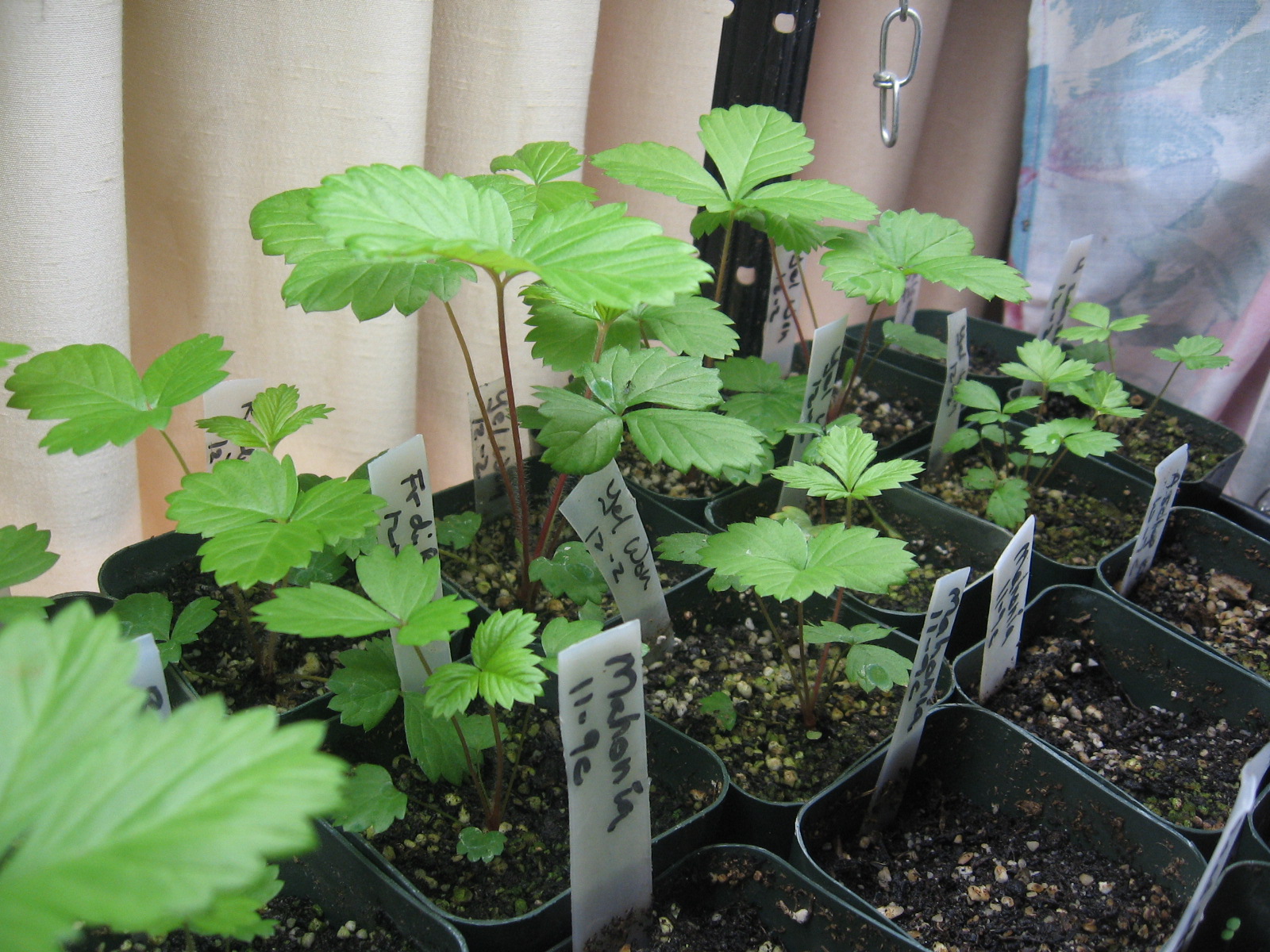
The Alpine strawberries sown in December are doing great, much bigger than ones sown in January.  They should be of a size to bloom and fruit this summer.
Well, have a nice restful remainder of the winter, and peruse those catalogs and internet sites for your plants to grow this year. 

Hannah

Wednesday, January 26, 2011

Joys of Winter Growing

Well, my seedlings from last month are getting larger.  I had to move the Butterfly Peas and Andrographis paniculata into my hydroponics set-up so they could get taller.  I clipped leaves off the lower stems of the Andrographis and pinched out the top  growth so I could dry some of the leaves and make the plants bushier.  I often grow herbs and at some point they die without my benefitting from their growth so I'm trying to actually use some. 
The Culantro, Eryngium foetidum, which has a flavor like Cilantro but is not related, is widely used in Mexico and Central America.  It is doing well and has been used in cooking a little so far.  The 6 varieties of Alpine Strawberries are coming along nicely and should be able to bloom and start bearing fruit sometime during the next summer.

In addition, I have some seedlings from seeds sown in October and  kept in the refrigerator until earlier this month.  The bottom right seedlings in the photo above are Hibiscus lasiocarpus.   Some Purple Milkweed, Asclepias purpurascens, came up as well.  And the very exciting Mertensia virginica, a Bluebell native to the eastern United States, has a single seedling up.  I failed to germinate any last year so it seems like quite an achievement.   Most pots are still sitting there with no growth, though.

More pots are in the refrigerator, among them some seeds that got temporarily mislaid that I found this week, all with edible berries, Rhus trilobata, Rhus aromatica, and Berberis fendleri, which High Country Gardens describes as tasting like sour cherries.  The rest are some new natives I'm attempting to grow, Houstonia rubra- very fragrant, Eriogonum ovalifolium, Asclepias asperula, Aquilegia formosa- a lovely red and yellow native columbine, and Agastache cusicki, a native licorice mint that needs chilling.

Under lights I'm starting more Agastaches- cana, aurantiaca, occidentalis, and rupestris.  These are very popular with bees and butterflies, and have fragrant foliage like peppermints and spearmints which are mostly non-native, but tend toward the anise and lemony fragrances.  They can also be used for flavoring dishes and dried for teas.  Some are starting to sprout at about 8 days after sowing.  I also sowed more strawberries, native Rudbeckia fulgida Goldsturm, and a lot of Dianthus superbus, the Fringed Pink, which has edible uses and is very fragrant.


I like to start some seeds by putting them in small ziplock bags from Michael's, with a piece of damp paper towel, so there is not as much loss as those started in pots.  Tomatoes, squash, and cucumbers do especially well like this.  Old seeds that failed to grow for me for several years in peat pots started this way.  I wait until the root has grown out a cm. or more then plant the seed in planting mix with a compost, peat moss, and perlite, which I heat in the microwave before planting to hopefully kill damping off fungus and fungus gnats.  So far I sprouted a bunch of Cardoon, and just started several eggplants.  Next will be some peppers and a few tomatoes, though after last year with so much cold weather in June and July, and consequent very late and poor tomato crops, I'm not growing many tomatoes this year.  I do hope to have good crops of beans, greens, cucumbers, and squash though, which did not seem very affected by the cool weather.

So, jump in and grow something under lights, it's fun to have only fungus gnats gnawing on my plants' roots instead of voles!

Hannah