Search This Blog

Saturday, October 15, 2011

More fall crops

I hope you still have something to harvest in your vegetable garden.  It's always hard for me seeing the end of the growing season.  I'm finally getting enough tomatoes after the long cold spring and early summer to cook down for sauce in my crockpot.   Here is part of one day's harvest.  Starting at the top, long skinny paste San Remo.  The fluted one clock-wise is labeled Azure Paste from Tanager Song Farms, I don't know if it is the correct tomato.  Then Rostova, a heart, 4 Martino's Roma, and continuing on the outside and under San Remos is the impressive New Big Dwarf, large pink tomatoes for a short determinate plant, with rugose leaves.  In the center is another TSF tomato, Novinka Kubani.  All these tomatoes are blemish-free.  Mountain Princess and Shilling's Giant Heart had the most cracking this year.
The fall rains started later this year so it may be a while before late blight may strike.  I did get a partial cover over my tomatoes this year, though not like my tomato house last year, which had wire fencing in the roof to prevent sagging plastic sheeting.   I'm also searching for drying pods among the bean plants for my seed-saving.   My runner beans are getting dry, so I have been shelling lots of them.  Last year I had solid black, violet with black specks, and violet with lots of black, but this year I had one plant with white flowers instead of red, and white seeds as well.  Magical beans.  These are Insuk's Wang Kong beans from a trade.  Insuk is a Korean lady gardener who introduced the runner beans here from Korea, I don't remember the exact story.
The turnips and other greens are going strong and will continue after frost and especially in late winter/early spring when they start growing again to go to seed, providing lots of greens when nothing else is available, and small clusters of flower buds like miniature broccoli.  This is a cylindrical turnip from Gourmet Seeds of  Italy, it weighed in at about a pound.
I cook the greens as well, they were favorites of mine along with other greens as a child.
The squash and cucumbers have their usual late season mildew and have slowed down in bearing from the cold temperatures.  But one variety of cucumber, Tanja, which I neglected to pick, has attained a mature size here with a 12"/30.5 cm ruler.  I peeled one, sliced and removed the seeds, and stir-fried it with mushrooms, onions, garlic, ginger, and Bragg's Liquid Aminos.  They can also be stuffed and roasted, or made into a cream soup with cream or coconut milk, which also works very well with pumpkin.

Here is something I'm trying for the first time, Cardoon, a thistle.

 One plant out of the 4 that I got planted in the ground grew large and is flowering, very prickly flowers.   I am supposed to wrap the stems to blanch them but have been too busy.  It is a very interesting thistle.  The stems are supposed to taste like artichoke hearts.

Well, if you have no vegetables to harvest at this point, you can still take advantage of the abundance of pumpkins to make the above mentioned soup, and spice it up with some Turmeric, Curry Powder, Ginger, or Cinnamon.

Hannah

Wednesday, October 5, 2011

Taming the Wild Blackberries

I'm working intensively at present on reducing the amount of out-of-control blackberries on my two acres. These consist mostly of Himalayan blackberries, Rubus armeniacus, brought over from Europe in 1885 by Luther Burbank.  These can get canes 20-30 feet long and grow up into trees, sometimes bending over the young and susceptible ones like an oak I planted at the edge of my woods, hard to see but at around a 30* angle from the big alder, bending out over the ladder.  Note the brown area where blackberries and stinging nettle have already been cut back, which will be mowed next year to maintain the space.  I will cut back the rest to our property line after the berries are done.  I have to get up on the ladder to pick them, and the ladder also gives perspective.
It is especially important to try to control the canes at this time of year because the fall rains are beginning in the Pacific Northwest (PNW) and the canes are starting to tip-root, the growing end in contact with the soil will dig in and form roots, thus multiplying and spreading the number of plants.  The other invasive blackberry, the native Rubus ursinus, AKA Vegetable Barbed Wire, also tip roots.  It is a smaller vine but very invasive, and can festoon smaller trees and shrubs and cover the ground.  It is not very productive of fruit, unlike the Himalayan blackberry, from which I have picked almost a quart of berries a day this year for a couple of months.   I make a gelatin dessert from it with unflavored beef gelatin or vegetarian (seaweed) gelatin, Stevia and a little honey for sweetening, and additions of other available berries, like the wild Oregon Holly Grapes, Thimbleberries and  Salal, or Aronia berries, or Mulberries.   For a sauce I also like to thicken it occasionally with Guar Gum, which must be added to cold water and stirred well to prevent lumping.  I get it from Azure Standard, a co-op on the west coast that has truck routes and drop points, but also ships UPS.

Best control of blackberries has been mowing, so I am presently involved in reducing areas in my yard that have been too overgrown to mow, or had barriers.  Sometimes this just involves cutting down a lot of blackberries, but in some areas I have to remove logs on the ground that have kept us from mowing in the past.  One log was harboring  a nest of termites!   Our previous owners logged the property and piled up a lot of big logs behind our shop. Many of these have been in place so long they are falling apart.  There are also brush piles which I considered wildlife refuges, so I am having to remove some of them.

  This area has been overrun with blackberries ever since we moved in, and still cannot be mowed, though the logs are starting to break down enough to crumble.  I picked up one small crumbly log and found a cute little nest of a salamander mother and her tiny puplets.  I hope she doesn't abandon them after being disturbed, though I am unable to find if she is actually caring for them at this point.  Here is the same area after several days cutting out vines and stacking them for chipping.  I left some wild roses and a few thimbleberries, and a native flowering currant.  I have a Trazel planted there as well, a hybrid Hazelnut.  But a couple of others self-sown trees will go.  The bamboo, shown in a previous post,  looks much nicer all weeded as well.

I am hoping to plant some shrubs with edible fruits there this fall or next spring, to provide some shade cover to discourage the blackberry vines.   Although I have been an organic gardener, I am using a very small amount of brush killer, Triclopyr, by applying it to the fresh cut surface of the canes with a bottle with small tubular applicator.  It does seem to help prevent regrowth of the cane.

Then there are areas where blackberry vines have crept in around the bases of rows of trees.  I hope to remove the vines and cut off lower limbs or remove dead trees as here, so I can mow in closer and reduce hand weeding and cutting.
Well, it's raining so I may have to postpone getting this one done, so I am going to post anyway.  Happy Fall!  BTW my MIL whom we cargive was 100 years old yesterday!

Hannah

Saturday, October 1, 2011

The Shell Game- Fall Bean Crops

I've been out searching for drying bean pods and still edible pods among the bean vines.  Here are some picked today.  The cute curved pods are the Yellow Shrimp Bean, purple streaked at maturity, Anellino Gialo from Gourmet Seeds of Italy.  The purple ones are thin Velour beans from Park Seed.  The green ones are the second sowing of Marconi Nano, a bush Marconi from GS.  Then the dry pods are runner beans, mostly Insuk's Wang Kong.
Anellino Gialo is a cute bean,  productive and tasty.  There are other colors of shrimp beans, green and a green with magenta streaks that look alot like my Uncle Steve heirloom pole beans.  A closer view
Here are some Uncle Steve's pole beans I picked today.

Here are some of my shelled bean seeds, all broad flat Romano types.   The brown ones are an heirloom bush bean, Yer Fasulyasi, from the Abundant Life Seed Foundation, which used to have a very wide range of heirloom vegetables and beans before they had a fire a few years ago.  The black ones are Marconi nano.    Another similar bean is Capitano, a yellow Romano bush bean from Park Seeds with white seeds.  All of these beans are very tasty and meaty, and seem to be staying tender into the larger stages with fully developed seeds.
Some pole beans appeared among my Marconi nano beans, a nice error, tasty and a good grower, with green pods with a purple blush.  They resemble 'Peck to a Hill' pole beans on the Heritage Harvest Seed website.  They have attractive black seeds with white mottling (below this photo).  I will grow more next year.
Another ALF heirloom, Pisarecka Zlutoluske, is an early yellow wax bean that seems very cold tolerant, I have planted it out on April 15 before, one month before my usual bean planting date, and had good crops of tender yellow beans with rosy seeds flecked with white spots.
I also have good yields of beans and seeds from Speedy (Gourmet Seeds, below), which was as fast as Pisarecka Zlutoluske, and the red-podded Velour (Park Seeds), which though small were slow to develope, both bush beans of the thin pencil shape, tender, delicate and delicious.  
Velour beans are quite thin but tender, here are the very messy mature dry pods that had flopped in the dirt.  It was good I picked them since it rained later.   
Since they were mostly dry I got them shelled, but they are difficult because the thin pods really stick onto the beans and don't want to split.  The Romanos by contrast have a pod wider than the beans and are easy to open.  But the Velour beans, below, did clean up nicely.  They are small, and become very hard small seeds when they dry so not good for shellies.

The runner beans, Insuk's Wang Kong, are beginning to dry out for picking pods for seeds.  I will probably eat some of them as shellies.  Here are the huge seeds from one pod taken with the other beans for comparison.
Have fun shelling those beans,  and find some good heirlooms to pass along.

Hannah

Wednesday, September 28, 2011

Wildflower Wednesday, September 28

Welcome to another Wildflower Wednesday, hosted by Gail, thanks for the photos of all the lovely wildflowers.  Check out her site and the other participants.  

Not many of  my wildflowers are blooming this fall, so here is the Evergreen Huckleberry instead-
Here is more fruit on Fragaria vesca, the Woodland Strawberry.
And nestled in a nice bowl made of fused leaves, some berries of the Western Trumpet Honeysuckle, Lonicera ciliosa-
The Oceanspray drapes itself with white frothy flowers every spring, but now they are brown reminders.
A reliable plant in the landscape here in the PNW is as tough as nails, transplants easily, and is a good filler, the Sword Fern-
Here are some Rudbeckias from a mixed packet of seed grown last year, unfortunately they all seemed to be annuals and did not return.

I'm looking forward to next year when some seed-grown natives may bloom.

Hannah

Wednesday, September 7, 2011

In Remembrance of Things Past- Daylily Season 2011

I had some renewed interest in my daylilies this summer because I needed to select some to give my daughter-in-law for her new house/garden.   One of my older beds was doing so great there was continuous bloom for weeks and weeds were not in evidence in the thick growth and flowering.  Tuscawilla Tigress kept one end on fire-
Along with the tropical peachy South Seas-
On the other end a fire was lit on Open Hearth, which is closer to a spider in form-
And also Mango Time, love those red eyezones!-
One that kept several lilting blossoms open every day at a nice shorter height, Rhinestone Kid, I love 
the clear color with the lighter midribs, ruffles, and twirly shape- 
-
And here showing several blossoms-
Another cool color that bloomed well, Purple Passage-
And a crimson red spider form, Poinsettia Love-
But of course I should also show the real Spider Man-
Some others that looked good in the clump, Hunter's Torch glowing from within-
Another twirly flower that kept blooming a long time, Decatur Cherry Smash-
Another clump that bloomed at a nice shorter height and kept multiple blooms going for a long time, Carrollwood Red-
The appropriately named Orchid Corsage like an ethereal gathering of starfish-
And a few that made very lovely flowers, blooming occasionally.  A fantastic purple bagel that looks like a lightning storm in an evening sky, Night Beacon-
The lovely bagel Hug Me Big by Ra Hansen, love those recurved petals-
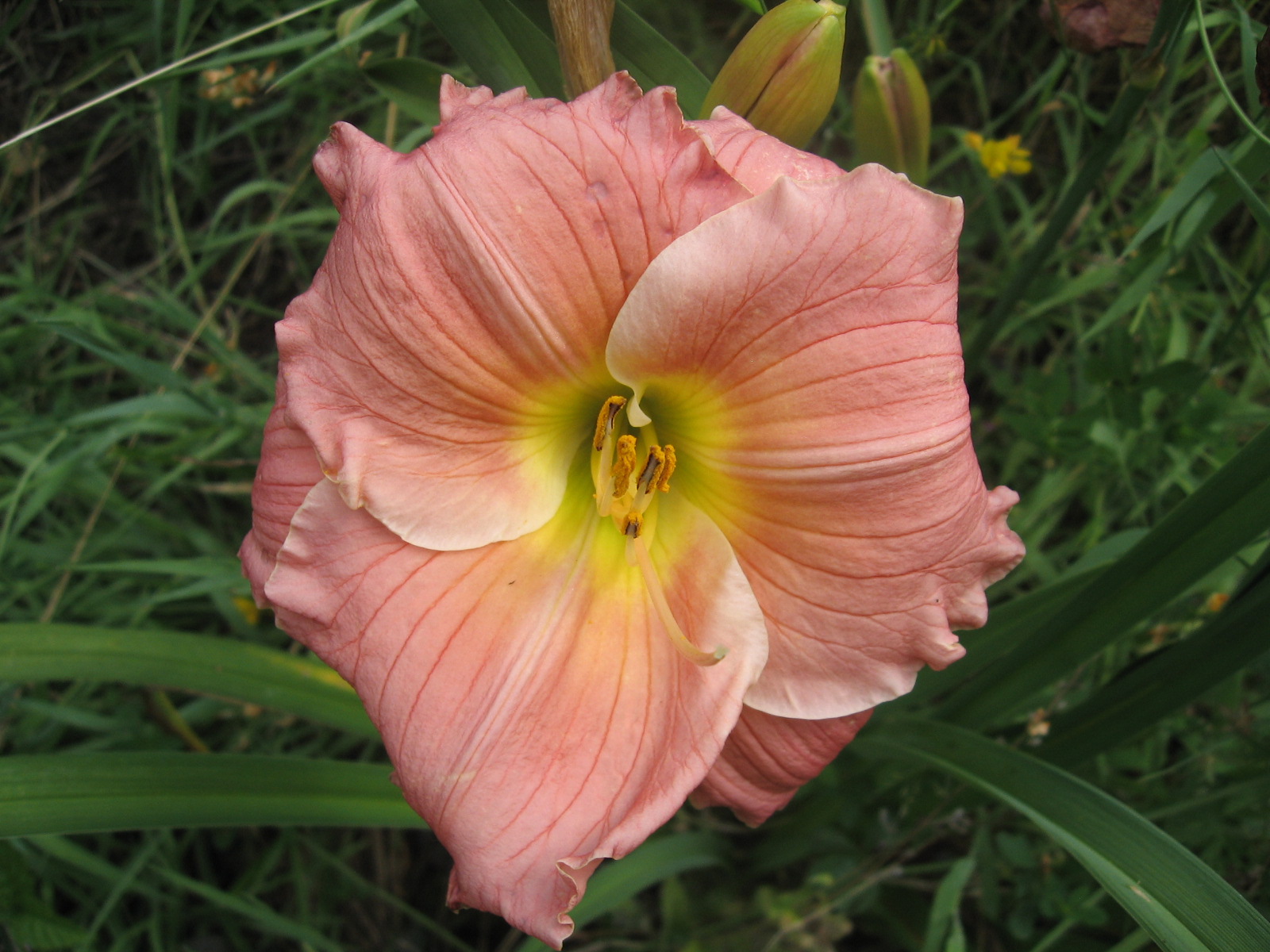
A lovely pastel pink with deeper eyezone, Janice Brown-
And the delicate bicolor Sunday Ruffles-
A perfect rounded form with ruffles, lovely pink, Rose Emily, love those rounded sepals with the little points, and the chartreuse throat-
The ruffled and pleated elegant form and color of Kate Carpenter-
And for eye appeal, a purple eyezone, I think on Wineberry Candy-
And the coolly elegant deeper purple eyezone of Moonlit Masquerade-
Well, it has been a dose of daylilies for your delight.   And there is always the allure of hybridizing your own creation of certainly one of the more persistent and easy perennials.   I have one bed of seedlings that is a blaze of glory in summer, many from the clownish Erin Farmer, a peach spidery form with a white midrib.  Unfortunately I kept neglecting to take a picture.

Hannah

Saturday, September 3, 2011

A New Garden for a Barberry

I was looking for a place to plant my latest acquisition, Berberis darwinii, a Barberry with an edible berry.   It is a wonderful evergreen shrub, not quite as hardy as I would like but hopefully enough.
fruit photo.
 It is deer-proof  because of spiny leaves and sharp thorns, so can be used for a barrier or used without fencing.  It does get quite large, around 10' tall and wide, but can be sheared.  It should be covered with flowers in spring.  flowers photo.

Its leaves below are smaller and glossier than those of the native Mahonias, Oregon Holly Grape, also in the Barberry family.
I decided on a neglected east-facing area near our woodshed, growing grass, blackberry vines, and other weeds, in the partial shade of a large Big-leaf Maple-
After clearing the ground with my mattock, I found it had a dip that I had to fill up with some with soil from around the yard, and molehills, which are easy when the ground is dry like a rock as at present.  Here is the area with the barberry planted and mulched with chips from blackberry vines, cedar boughs, maple boughs, etc.- we've been doing a lot of trimming and chipping to get ready for fall mulching.   The black edging will be installed when the ground softens up from some rain eventually, and a grass border will be left on the driveway edge for stray cars and lawnmowers.  I hope it will grow well there.
I also have some Berberis fendleri seedlings from a previous post, that may get planted behind the woodshed this fall or wait until next spring.  They also have an edible but smaller berry, reputed by High Country Gardens to taste like sour cherries.  It is native to New Mexico and much hardier.

I am presently busy harvesting fruit from wild berries like blackberries, Oregon Holly Grape (Mahonia nervosa), and Salal, which taste good mixed together and also with Illinois Everbearing Mulberries and Aronia berries.  I like to make either gelatin (unflavored beef gelatin or vegetarian from seaweed) with Stevia for a sweetener, or a thickened fruit sauce with Guar Gum as a thickener and Stevia for a sweetener.  I'm also getting early fruit from William's Pride Apple, clockwise Harrow Delight Pear, Desert King Fig, and Ubileen pear, mostly from Raintree Nursery.  Rescue Pear will be coming up, aromatic fruit so large you need to be rescued if it falls on your head!  And also Greensleeves  Apple, early, mostly bug-free, and aromatic.
Happy Labor Day weekend!

Hannah